Monday, 25 April 2022

ACLU: The Supreme Court Must Protect Students From School-Sponsored Prayer | American Civil Liberties Union

The Supreme Court Must Protect Students From School-Sponsored Prayer | American Civil Liberties Union

On-duty public-school staff may not pray with students. Period. That’s been the law under the First Amendment’s Establishment Clause for more than half a century. Even the Trump administration—hardly a bastion of church-state separation—agreed, proclaiming in its school-prayer guidance that “school employees are prohibited by the First Amendment from encouraging or discouraging prayer, and from actively participating in such activity with students.” But that could soon change if the Supreme Court rules in favor of a public-school football coach who demanded the right to lead his players in prayer at the 50-yard-line at the end of each game.

This morning, the court is hearing oral arguments in Kennedy v. Bremerton School District, in which Joseph Kennedy, a former high school football coach, claims that school officials in Bremerton, Washington violated his religious-exercise and free-speech rights by placing him on administrative leave for repeatedly leading on-field prayers with his team at the close of each football game.

The coach portrays the case as involving his right to personal, silent prayer. But as a Ninth Circuit Court of Appeals judge pointed out in ruling against the coach, Kennedy and his attorneys have repeatedly misrepresented the facts of the case, spinning a “false” and “deceitful narrative.” In truth, the school offered — and Kennedy rejected — several religious accommodations that would have allowed him to engage in private, post-game prayer. Instead, he insisted on continuing his unconstitutional practice of praying with students.

The Supreme Court has long recognized that the separation of religion and government is especially important in our public schools, which must equally serve students of all faiths, and those of none. When public-school officials demonstrably favor some faiths over others or promote religious doctrine, it sends a message of exclusion to students who don’t follow the preferred faith. And students are especially vulnerable to coercion, both subtle and overt, when subjected to school-sponsored prayer or other official religious exercise.

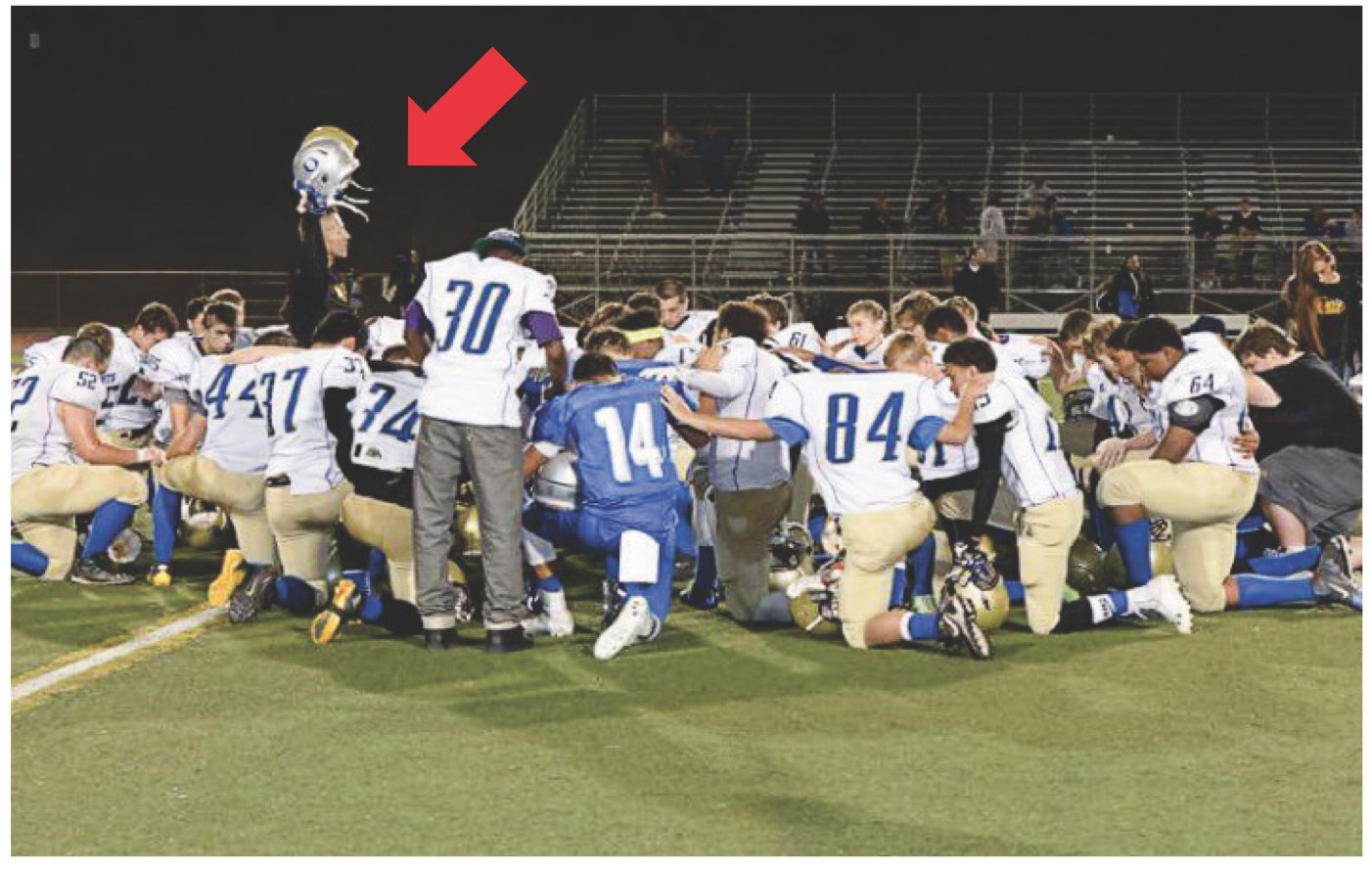
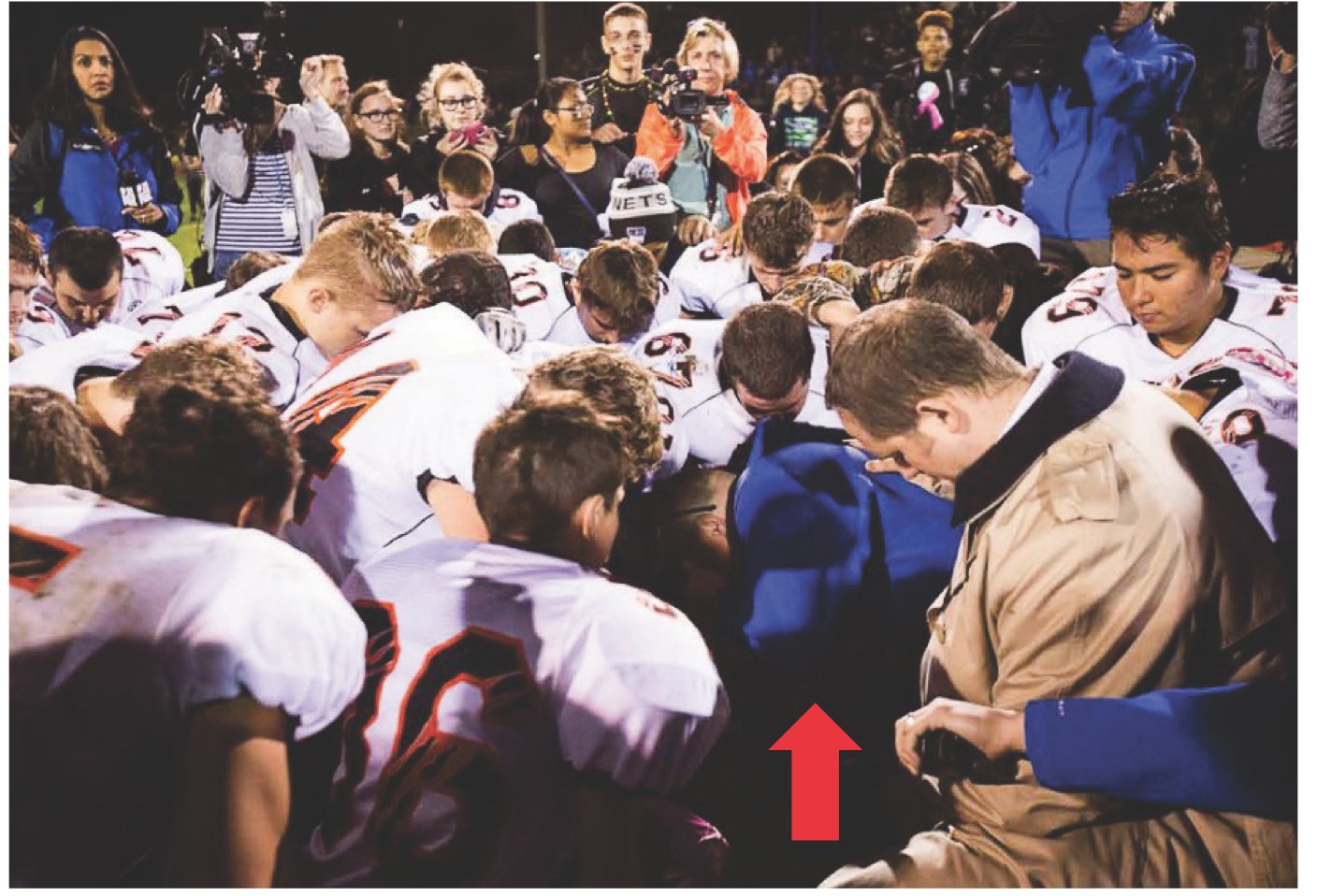
Students being led in prayer by their coach at a Bremerton School District high school. A red arrow is juxtaposed on the image pointing to the coach.

Indeed, several of Coach Kennedy’s players participated in his prayers only because they felt pressured to do so. As one amicus brief — filed on behalf of former professional football players and former college athletes — explains, coaches wield great power and influence over their athletes. Many players are naturally inclined to view their coaches as authority figures and to obey their explicit and implicit commands. Athletes understandably seek the approval of their coaches, who control nearly all aspects of their participation and playing time. For some high school students, coaches may be instrumental in their ability to obtain collegiate athletic scholarships. Under the gaze of their coaches, fellow team members, the audience, and the media who gathered to cover Kennedy’s highly publicized prayer, few students would feel comfortable opting out of the post-game prayer huddle.

The ACLU strongly supports the free exercise of religion and free speech. Earlier this year, for example, we filed an amicus brief with the Supreme Court, arguing that the City of Boston unconstitutionally denied a Christian group’s request to fly, for a single hour, a flag featuring a cross on a city flagpole. The city denied the request even though it had intentionally opened up the flagpole as a public forum and consistently allowed dozens of other groups to temporarily raise their flags. The flag in that case, we explained, was private speech and would be understood as such by the community, and therefore had to be accommodated.

Not so in Bremerton. Kennedy conceded that he delivered his prayers while he was on the job, explaining to the press that the prayers were, in his view, “helping these kids be better people.” Even if the school disclaims any endorsement, a student who witnesses the coach lead his team in prayer would still perceive it as bearing the school’s stamp of approval. And anyone familiar with the coach-athlete relationship would immediately understand just how coercive that practice is. In barring him from praying with students in this setting, while offering him many ways to pray privately, school officials did only what was required of them by the First Amendment: They protected students’ religious freedom by shielding them from school-sponsored religious exercise. Now, it’s the Supreme Court’s turn to do the same.

Stay informed about our work
Sign up

Published April 25, 2022 at 02:00PM
via ACLU https://ift.tt/DXE50SK

Thursday, 21 April 2022

ACLU: The Law & Order Reboot Could Not Come at a Worse Time for Criminal Law Reform

The Law & Order Reboot Could Not Come at a Worse Time for Criminal Law Reform

You might think you know a lot about the criminal justice system in America. Perhaps you have a vision of what happens at arrest, during police questioning, when bail is set, or during trial. You’ve heard the familiar Miranda warnings on TV and seen lawyers spouting objections in courtroom scenes. However, if you are like many people, whose views on the criminal legal process are primarily formed by TV and movies, you may have a woefully rosy picture of how accused people are treated in thousands of courtrooms across the country every day.

A huge culprit in misshaping Americans’ views of their local criminal legal systems is the hit show Law & Order, the longest-running law enforcement series on television, which is now back on air for its 21st season. While unquestionably a successful entertainment franchise, Law & Order and shows like it have done incredible damage to the fight for a truly fair and effective criminal justice system. This is because a vast segment of the American public is getting their information about the legal system from shows like Law & Order, and in many critically-important ways, the fiction of the show is nothing like reality.

For example, take bail. On TV, we watch people proceed swiftly to a real hearing following an arrest, in front of a judge, with a lawyer representing them. Arguments get made about whether the person poses a flight risk or an unmanageable danger to others if released. An individualized assessment is then made.

In reality, in much of the country, someone arrested and accused of a crime has their bail set without any hearing whatsoever: Bail is predetermined by charge without consideration of a person’s finances or other factors. Elsewhere, bail is set by a police officer, judge, or clerk behind closed doors. Even in places that hold some sort of bail hearing, the proceeding typically lasts only a few seconds, and people accused of crimes often have no lawyer to help them make arguments, preserve other rights (such as the right against self-incrimination), or to negotiate with the prosecutor. The result is a massive system of wealth-based and unjustified incarceration. This decision point influences the entire remainder of a person’s case, as those who cannot pay bail are incarcerated, separated from their families, left to prepare their defense from jail, and housed in often-abysmal, sometimes deadly conditions.

On TV, judges apply the law meticulously. In reality, many judges express overt bias, act rashly, and are condescending and cruel to criminal defendants. As a lawyer investigating practices on behalf of the ACLU, it is not uncommon for me to observe knee-jerk reactions from judges based on one element of the case, or to see judges show obvious preference to wealthier white defendants over low-income people of color. But members of the public rarely observe judges in action. When local and national journalism accurately covers judicial conduct, members of the public are often shocked by the way local judicial officers wield power.

On Law & Order, about 60 percent of cases go to trial. In reality, only about 2 percent of people have a criminal trial, largely because of the prevalent role of coercive plea bargaining, pressures of pretrial detention, and the lopsided balance of power between the prosecution and defense.

The perception driven by TV crime dramas that police are primarily investigating serious, violent crimes and are largely accurate in who they accuse is incredibly damaging. In reality, violent crimes only represent about 4 percent of law enforcement’s scope, and clearance rates — the number of reported crimes matched to an arrest — are under 50 percent for violent crimes and under 17 percent for property crimes.

Now, we are witnessing a misguided backlash to much-overdue criminal law reforms in America. Political opportunists are peddling suggestive, inaccurate narratives about crime, safety, and fairness. The truth is that harsh criminal law policies do not make communities safer, and reforms are not the reason for tragic instances of interpersonal violence. To understand why reforms that seek alternatives to incarceration continue to be desperately needed, it is essential that voters understand what their elected judges, prosecutors, and law enforcement chiefs actually do when they are entrusted to uphold the constitutional rights of everyone in the system.

In the meantime, it behooves the writers and producers of much-streamed shows to portray these issues with more nuance and accuracy — including by hiring defense attorneys and formerly-incarcerated people, and not just prosecutors and cops to consult in their writers’ rooms. Creators of TV crime dramas must recognize and take responsibility for the tremendous impact they have on the way jurors and voters perceive our justice system.

We need you with us to keep fighting
Donate today

Published April 21, 2022 at 11:55PM
via ACLU https://ift.tt/rJDtzCc

ACLU: The Law & Order Reboot Could Not Come at a Worse Time for Criminal Law Reform

The Law & Order Reboot Could Not Come at a Worse Time for Criminal Law Reform

You might think you know a lot about the criminal justice system in America. Perhaps you have a vision of what happens at arrest, during police questioning, when bail is set, or during trial. You’ve heard the familiar Miranda warnings on TV and seen lawyers spouting objections in courtroom scenes. However, if you are like many people, whose views on the criminal legal process are primarily formed by TV and movies, you may have a woefully rosy picture of how accused people are treated in thousands of courtrooms across the country every day.

A huge culprit in misshaping Americans’ views of their local criminal legal systems is the hit show Law & Order, the longest-running law enforcement series on television, which is now back on air for its 21st season. While unquestionably a successful entertainment franchise, Law & Order and shows like it have done incredible damage to the fight for a truly fair and effective criminal justice system. This is because a vast segment of the American public is getting their information about the legal system from shows like Law & Order, and in many critically-important ways, the fiction of the show is nothing like reality.

For example, take bail. On TV, we watch people proceed swiftly to a real hearing following an arrest, in front of a judge, with a lawyer representing them. Arguments get made about whether the person poses a flight risk or an unmanageable danger to others if released. An individualized assessment is then made.

In reality, in much of the country, someone arrested and accused of a crime has their bail set without any hearing whatsoever: Bail is predetermined by charge without consideration of a person’s finances or other factors. Elsewhere, bail is set by a police officer, judge, or clerk behind closed doors. Even in places that hold some sort of bail hearing, the proceeding typically lasts only a few seconds, and people accused of crimes often have no lawyer to help them make arguments, preserve other rights (such as the right against self-incrimination), or to negotiate with the prosecutor. The result is a massive system of wealth-based and unjustified incarceration. This decision point influences the entire remainder of a person’s case, as those who cannot pay bail are incarcerated, separated from their families, left to prepare their defense from jail, and housed in often-abysmal, sometimes deadly conditions.

On TV, judges apply the law meticulously. In reality, many judges express overt bias, act rashly, and are condescending and cruel to criminal defendants. As a lawyer investigating practices on behalf of the ACLU, it is not uncommon for me to observe knee-jerk reactions from judges based on one element of the case, or to see judges show obvious preference to wealthier white defendants over low-income people of color. But members of the public rarely observe judges in action. When local and national journalism accurately covers judicial conduct, members of the public are often shocked by the way local judicial officers wield power.

On Law & Order, about 60 percent of cases go to trial. In reality, only about 2 percent of people have a criminal trial, largely because of the prevalent role of coercive plea bargaining, pressures of pretrial detention, and the lopsided balance of power between the prosecution and defense.

The perception driven by TV crime dramas that police are primarily investigating serious, violent crimes and are largely accurate in who they accuse is incredibly damaging. In reality, violent crimes only represent about 4 percent of law enforcement’s scope, and clearance rates — the number of reported crimes matched to an arrest — are under 50 percent for violent crimes and under 17 percent for property crimes.

Now, we are witnessing a misguided backlash to much-overdue criminal law reforms in America. Political opportunists are peddling suggestive, inaccurate narratives about crime, safety, and fairness. The truth is that harsh criminal law policies do not make communities safer, and reforms are not the reason for tragic instances of interpersonal violence. To understand why reforms that seek alternatives to incarceration continue to be desperately needed, it is essential that voters understand what their elected judges, prosecutors, and law enforcement chiefs actually do when they are entrusted to uphold the constitutional rights of everyone in the system.

In the meantime, it behooves the writers and producers of much-streamed shows to portray these issues with more nuance and accuracy — including by hiring defense attorneys and formerly-incarcerated people, and not just prosecutors and cops to consult in their writers’ rooms. Creators of TV crime dramas must recognize and take responsibility for the tremendous impact they have on the way jurors and voters perceive our justice system.

We need you with us to keep fighting
Donate today

Published April 21, 2022 at 07:25PM
via ACLU https://ift.tt/rJDtzCc

ACLU: Documents Reveal Confusion and Lack of Training in Texas Execution

Documents Reveal Confusion and Lack of Training in Texas Execution

As Texas seeks to execute Carl Buntion today and Melissa Lucio next week, it is worth reflecting on the grave and irreversible failures that occurred when the state executed Quintin Jones on May 19, 2021. For the first time in its history — and in violation of a federal court’s directive and the Texas Administrative Code — Texas excluded the media from witnessing the state’s execution of Quintin Jones. In the months that followed, Texas executed two additional people without providing any assurance that the underlying dysfunction causing errors at Mr. Jones’ execution were addressed. This is particularly concerning given that Texas has executed far more people than any other state and has botched numerous executions.

The First Amendment guarantees the public and the press have a right to observe executions. Media access to executions is a critical form of public oversight as the government exerts its power to end a human life. Consistent with Texas policy, two reporters travelled to the Huntsville Unit, where executions take place, to witness the execution of Mr. Jones in May 2021. The reporters waited across the street from the execution chamber, but Texas inexplicably excluded them from witnessing the execution.

Immediately after this fundamental and unconstitutional breakdown in procedure, Texas vowed to investigate what went wrong. The investigation resulted in the issuance of a perfunctory statement asserting without evidence that “extensive training” was conducted prior to the execution, but that issues still occurred. In June 2021, the ACLU submitted a request under the Texas Public Information Act for documents related to the errors at Mr. Jones’ execution and the investigation that followed. After six months of stonewalling during which time Texas executed two more people, the Texas Department of Criminal Justice (TDCJ) released troubling new documents. These documents reveal a department woefully unprepared to carry out an execution, due to confusion and lack of training.

The documents describe interviews with staff who reported “a lot of unwritten procedures,” confusion about whether there were any written guidelines or protocols about executions, a lack of a “clear understanding of [their] role,” and staff who were “not trained.” An interview with one individual who appears to have participated in previous executions revealed that “to [his] knowledge, there are no written guidelines/protocols about the execution itself. He is aware of a document titled Execution Procedure-April 2021, however he stated he has not read it thoroughly.” Multiple documents describe a picture of confusion as a result of “all the changes,” including changes in the execution process. Taken together, these documents reveal a global lack of understanding about execution procedures generally.

The documents, which TDCJ tried for months to withhold, make clear that the department is not prepared to carry out another execution in line with Texas policy or the Constitution. While excluding media from an execution is easily noticeable, other errors may be less apparent. When the state makes a mistake in executing a person, those mistakes are unfixable and inexcusable. There is no room for error when the final moments of a person’s life are on the line.

There are countless reasons to oppose executions: the failure to protect innocent lives, the systemic racial bias in the application of the death penalty, and prosecutorial misconduct in capital cases are just a few examples. Mr. Buntion, scheduled to be executed today, is 78-years-old and has medical vulnerabilities. Ms. Lucio, scheduled to be executed next week, has a strong case for her innocence and has the support of her surviving children. The TDCJ should not move forward with these executions. Texas’ mismanagement in carrying out past executions is yet another reason the state should abandon the cruel practice of capital punishment.


What you can do:
Further Racial Justice: Attend a Systemic Equality Event
RSVP


Published April 21, 2022 at 11:12PM
via ACLU https://ift.tt/pinevgD

ACLU: Documents Reveal Confusion and Lack of Training in Texas Execution

Documents Reveal Confusion and Lack of Training in Texas Execution

As Texas seeks to execute Carl Buntion today and Melissa Lucio next week, it is worth reflecting on the grave and irreversible failures that occurred when the state executed Quintin Jones on May 19, 2021. For the first time in its history — and in violation of a federal court’s directive and the Texas Administrative Code — Texas excluded the media from witnessing the state’s execution of Quintin Jones. In the months that followed, Texas executed two additional people without providing any assurance that the underlying dysfunction causing errors at Mr. Jones’ execution were addressed. This is particularly concerning given that Texas has executed far more people than any other state and has botched numerous executions.

The First Amendment guarantees the public and the press have a right to observe executions. Media access to executions is a critical form of public oversight as the government exerts its power to end a human life. Consistent with Texas policy, two reporters travelled to the Huntsville Unit, where executions take place, to witness the execution of Mr. Jones in May 2021. The reporters waited across the street from the execution chamber, but Texas inexplicably excluded them from witnessing the execution.

Immediately after this fundamental and unconstitutional breakdown in procedure, Texas vowed to investigate what went wrong. The investigation resulted in the issuance of a perfunctory statement asserting without evidence that “extensive training” was conducted prior to the execution, but that issues still occurred. In June 2021, the ACLU submitted a request under the Texas Public Information Act for documents related to the errors at Mr. Jones’ execution and the investigation that followed. After six months of stonewalling during which time Texas executed two more people, the Texas Department of Criminal Justice (TDCJ) released troubling new documents. These documents reveal a department woefully unprepared to carry out an execution, due to confusion and lack of training.

The documents describe interviews with staff who reported “a lot of unwritten procedures,” confusion about whether there were any written guidelines or protocols about executions, a lack of a “clear understanding of [their] role,” and staff who were “not trained.” An interview with one individual who appears to have participated in previous executions revealed that “to [his] knowledge, there are no written guidelines/protocols about the execution itself. He is aware of a document titled Execution Procedure-April 2021, however he stated he has not read it thoroughly.” Multiple documents describe a picture of confusion as a result of “all the changes,” including changes in the execution process. Taken together, these documents reveal a global lack of understanding about execution procedures generally.

The documents, which TDCJ tried for months to withhold, make clear that the department is not prepared to carry out another execution in line with Texas policy or the Constitution. While excluding media from an execution is easily noticeable, other errors may be less apparent. When the state makes a mistake in executing a person, those mistakes are unfixable and inexcusable. There is no room for error when the final moments of a person’s life are on the line.

There are countless reasons to oppose executions: the failure to protect innocent lives, the systemic racial bias in the application of the death penalty, and prosecutorial misconduct in capital cases are just a few examples. Mr. Buntion, scheduled to be executed today, is 78-years-old and has medical vulnerabilities. Ms. Lucio, scheduled to be executed next week, has a strong case for her innocence and has the support of her surviving children. The TDCJ should not move forward with these executions. Texas’ mismanagement in carrying out past executions is yet another reason the state should abandon the cruel practice of capital punishment.


What you can do:
Further Racial Justice: Attend a Systemic Equality Event
RSVP


Published April 21, 2022 at 06:42PM
via ACLU https://ift.tt/pinevgD

Monday, 18 April 2022

ACLU: A Student’s Journey: Fighting for Education Rights While in Prison

A Student’s Journey: Fighting for Education Rights While in Prison

Young people with disabilities have a legal right to a free and appropriate public education, even when they are incarcerated. But for years, the educational needs of high school students in New Jersey’s state prisons were not being met.

That’s changing now, and Brian Y. is a big reason why.

Brian Y. entered state prison before he turned 18. He knew he had a right to an education inside, and he knew that as a student with disabilities, he was entitled to special education and related services.

He also knew his rights were being violated. So he took action.

The lawsuit, Adam X. et al. v. New Jersey Department of Corrections and Department of Education et al., was initiated five years ago by three students — Adam X., Brian Y., and Casey Z. (pseudonyms) — who alleged they were denied special education in prison. Thanks to their calls for change, the students’ legal team, including the ACLU of New Jersey Foundation, Disability Rights Advocates, and Proskauer Rose LLP, spent years investigating and litigating the case, which was certified by the federal District Court for the District of New Jersey as a class action in July 2021.

Their work was rewarded: On March 3, 2022, the District Court granted final approval of a settlement agreement that will usher in new policies to guarantee that students with disabilities in New Jersey prisons receive the special education and related services they are entitled to. The settlement also provides opportunities for make-up services and funds for those who were deprived special education in prison in the past, and ensures meaningful implementation of the new policies through a five-year monitoring plan.

Estimates suggest over 400 people may be impacted by the settlement — Brian Y. himself will receive $32,000 in compensatory education funds as part of the agreement.

We spoke with Brian Y., now 24 years old, about his education in prison and how his action resulted in a landmark settlement that will change the lives of young people denied services in prison. He talked about the experience in his own words.

This interview, which originally appeared on the ACLU of New Jersey’s blog, has been edited for clarity.

ACLU-NJ: What made you decide to take action to get an equal education?

Brian Y: I knew from my time in regular school that what was happening wasn’t normal. But all of this was my first time in jail or prison, so I thought that it was the norm: A tenth grader and a seventh grader all in the same class.

I was getting frustrated. I’d think to myself: “How is it that we have a teacher who doesn’t know the answer to certain questions?”

I brought this up with [an advocate]. They were shocked. So, they introduced me to the ACLU-NJ. And from there, the doors opened.

ACLU-NJ: What were the school materials you had like?

Brian Y: We didn’t even have textbooks. They had been recycled for years and were so outdated. The majority of the whole prison was working on the same lessons because it was the only thing they had available.

The teachers are supposed to be there for us, to teach us, but it was a jail mindset, just babysitting — they’d slide worksheets under the door.

ACLU-NJ: When you were in administrative segregation, you received instruction in a literal cage. What was it like to be educated in an environment like that?

Brian Y: I was so young. I don’t even know how to describe it. I felt like an animal.

I’m sitting in a room right now looking at a square table. Now, imagine us in a room. It’s you and the table, and everything around you is three stories high. Everyone is looking down at you.

And you’re in the middle, with lights on you, and a cage all around you. People outside are screaming and yelling. You’re trying to focus — but how can you? You can’t focus.

I remember being in the cage constantly jumping from the sounds. You could put your hand down and unintentionally make a loud noise. You’d hear people folding and stepping on the milk and juice cartons to make popping sounds. You would hear the metal keys. Everything was a loud noise. It was painful. It’s unreal, still thinking about it now. It was sad.
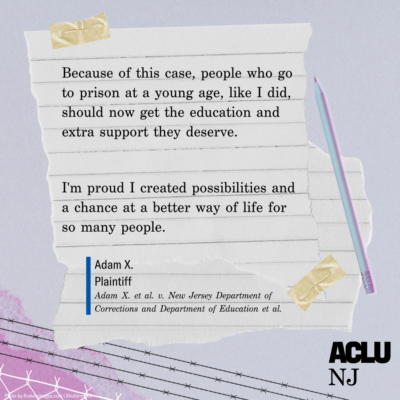
Image of a quote that reads: “Because of this case, people who go to prison at a young age, like I did, should not get the education and extra support they deserve. I’m proud I created possibilities and a chance at a better way of life for so many people.” — Adam X., Plaintiff

ACLU-NJ: What are your thoughts about missing out on educational services that you should have received?

Brian Y: The seven years I spent in the Department of Corrections, I was cheated out of education, and not learning the things I would have been if I was getting the right education. It’s going to have a huge impact on my life. You know everyone tells you, “Pay attention in school, you’re going to need it.” And here I am now saying the same thing.

ACLU-NJ: You were critical to the development of this case. What was it like to help your lawyers develop the complaint and prepare the suit?

Brian Y: It was exciting being a part of the lawsuit. It was unbelievable. It was like out of a movie. I was like an undercover lawyer. I’d ask questions in the classroom to find out what kinds of services other students were getting — or really, what services they weren’t.

Imagine being locked up at that age and having another inmate coming up to you and asking: “Do you have an IEP? What grade are you in? Why are you doing the same packet I’m doing? Do you get extra tutoring?”

A lot of the work I did to investigate took place when I was put in solitary confinement, taking notes on whatever small pieces of paper I had so I could use them later. Even helping other inmates to fill out forms for legal help: if they couldn’t mail it out themselves, I would put a stamp on it and make sure it got out.

Everyone I talked to or interviewed had a different story, and I was excited to see what impact they could have. It was a challenge for me — to see what I could uncover, or what role the next person I could get involved would have.

ACLU-NJ: After feeling like your concerns were ignored for so long, what was it like after you and your lawyers initiated the suit?

Brian Y: It felt amazing. Like 21 Jump Street, where an investigation blows up, and you laugh about it afterward.

I knew first when the lawsuit was announced and it was covered in the news, because all the teachers started finding out and losing their mind.

Deep down inside, I’m like, “I’m the man, I did this work. I made it happen!” I felt very overwhelmed and joyful.

ACLU-NJ: What did it feel like when you signed the settlement agreement, with your signature on the same document as the Department of Corrections commissioner?

Brian Y: Since getting out, I became a business owner. But signing my name to the changes the Department of Corrections would make felt even more powerful than turning the key to my shop for the first time.

There are so many people inside who have been there for years but didn’t have a way to change anything. Being so young and managing to make the change that we did is amazing.
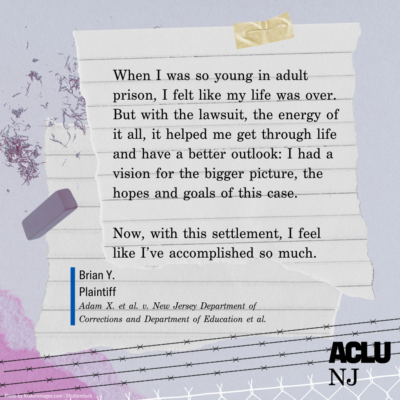
Image of a quote that reads: “When I was so young in adult prison, I felt like my life was over. But with the lawsuit, the energy of it all, it helped me get through life and I have a better outlook: I had a vision for the bigger picture, the hopes and goals of this case. Now, with this settlement, I feel like I’ve accomplished so much.” — Brian Y., Plaintiff

ACLU-NJ: What differences do you think we’ll see from before the settlement and after?

Brian Y: That’s a good question. And a scary question.

With the settlement and the changes that are coming, there will be new requirements, a monitor to make sure they’re carried out, and all that. It’s scary, because there’s so much that needs to be done. Even when the lawsuit first broke — a lot of people weren’t ready for it.

But it’s good. Because you’re going to see the teachers who want to help, the ones who love education — they’re the ones who are going to stay. Those are the folks going to their boss saying, “We’re not doing enough to teach people.”

For the inmates who want to turn their lives around, they’re going to love this. There are so many people who want to learn but we were limited. The hope is for this lawsuit to lift those barriers. We weren’t getting special education services, let alone basic education or vocational training that we wanted. After this, things will hopefully change to give people the tools we need to be successful.

ACLU-NJ: How does it feel now, knowing you were a teenager when you started down this journey?

Brian Y: When I was so young in adult prison, I felt like my life was over. But with the lawsuit, the energy of it all, it helped me get through life and have a better outlook: I had a vision for the bigger picture, the hopes and goals of this case. Now, with this settlement, I feel like I’ve accomplished so much.

Knowing you’re the reason so many students in this predicament are going to have so much opportunity: It definitely means a lot. Especially coming from the bottom — coming up in a troubled environment, with early run-ins — making your voice heard and having a voice means a lot.

When I talk about it, it means so much to me, I really hold back tears. Sometimes I think to myself, “How did I get through it?” To deal with all of it, to become more powerful, to make change like that — it’s so good. Even with the mistakes I made in life, I feel good about who I truly am.

Coming from all the way from the beginning of this case, to now standing up and shouting — having a voice! shouting! — it means a lot. I try to laugh a lot. As I’m talking about it, it really means a lot to me. And the laughing is really holding back tears.
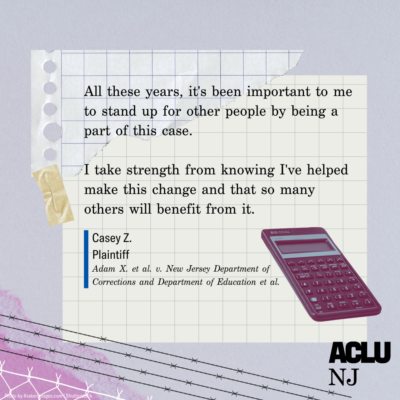
Image of a quote that reads: “All these years, it’s been important to me to stand up to other people by being part of this case. I take strength from knowing I helped make this change and that so many others will benefit from it.” Casey Z., Plaintiff

ACLU-NJ: What does it mean to know that you made it possible for people to get an education closer to the one they deserve?

Brian Y: To me this means my voice was heard. And for the other students in the class action, our voices were heard. Luckily, I was able to initiate positive change. I know this is going to break barriers, and it’s going to continue moving in the right direction, and this is just the start.

And I know there are teachers in there who want to do real lesson plans, want to really teach. I feel like I made a difference not just for students who want to learn but also for teachers who didn’t have a voice and wanted to teach.

ACLU-NJ: The settlement gives you and others in your circumstances opportunities to pursue education and training to compensate for what you were denied. What does that mean to you personally?

Brian Y: The compensatory education funds mean a lot. I had never had that help, but I’m being helped now. It’s kind of late, in terms of the Department of Corrections trying to make up for an education that we missed at such an important age, but I feel incredibly proud to finally have these opportunities and to know I was part of that. The people who care about me encourage me to stick with my passion, so I never gave up. I was even contacting technical colleges.

But when we first talked about the settlement, more than the comp ed, it was about the DOC changes for me — so other people didn’t have to go through what I did, so they can get proper education.

ACLU-NJ: Already more than 90 people have submitted compensatory education forms as part of the program created for class members. Are you proud of that?

Brian Y: Like I said — I like to challenge myself now because of the ACLU and everyone else. Ninety — that’s still short for us, because I know there’s a lot more than that who are eligible. This is just the beginning but we’re going to get there.

ACLU-NJ: Did you ever think about not taking action to fix things?

Brian Y: With this whole case, I could have just kept going with the flow, saying to myself this is normal. People could have said, “You’re in tenth grade doing seventh grade work – that’s all good, you’re guaranteed to pass.” But I couldn’t — it’s not right.

I never asked myself what if I didn’t get involved with the suit, because I’m so glad I did. But if I didn’t — it’d be the same now as it was then: A lot of people missing out on education. Every step of the way just made me want to fight harder, work more. We made our voices heard for ourselves and for other people who wanted to help. I was so committed, and I knew what was at stake.

ACLU-NJ: Five years later, what lessons do you take away from this?

Brian Y: From when we first started the class action to now — five years doesn’t feel like five years. But to get things done right, it takes time. To get it done right and to see real change. The investigation process, the manpower, everything, it was well due. Well due. I just roll with the punches. I know it’s not a simple change. This is a big, big change. It’s only right that it takes its time and goes through the process so we can get it RIGHT. We want it to be 100.

Class Members may continue to submit Compensatory Education Forms for up to two years. Although the notice period is complete, Class Members and their loved ones may still reach out to Class Counsel at prisoneducation@aclu-nj.org or prisoneducation@dralegal.org or by calling 973-854-1700.

Stay informed about our work
Sign up

Published April 18, 2022 at 08:58PM
via ACLU https://ift.tt/MbTUHa2
ACLU: A Student’s Journey: Fighting for Education Rights While in Prison

A Student’s Journey: Fighting for Education Rights While in Prison

Young people with disabilities have a legal right to a free and appropriate public education, even when they are incarcerated. But for years, the educational needs of high school students in New Jersey’s state prisons were not being met.

That’s changing now, and Brian Y. is a big reason why.

Brian Y. entered state prison before he turned 18. He knew he had a right to an education inside, and he knew that as a student with disabilities, he was entitled to special education and related services.

He also knew his rights were being violated. So he took action.

The lawsuit, Adam X. et al. v. New Jersey Department of Corrections and Department of Education et al., was initiated five years ago by three students — Adam X., Brian Y., and Casey Z. (pseudonyms) — who alleged they were denied special education in prison. Thanks to their calls for change, the students’ legal team, including the ACLU of New Jersey Foundation, Disability Rights Advocates, and Proskauer Rose LLP, spent years investigating and litigating the case, which was certified by the federal District Court for the District of New Jersey as a class action in July 2021.

Their work was rewarded: On March 3, 2022, the District Court granted final approval of a settlement agreement that will usher in new policies to guarantee that students with disabilities in New Jersey prisons receive the special education and related services they are entitled to. The settlement also provides opportunities for make-up services and funds for those who were deprived special education in prison in the past, and ensures meaningful implementation of the new policies through a five-year monitoring plan.

Estimates suggest over 400 people may be impacted by the settlement — Brian Y. himself will receive $32,000 in compensatory education funds as part of the agreement.

We spoke with Brian Y., now 24 years old, about his education in prison and how his action resulted in a landmark settlement that will change the lives of young people denied services in prison. He talked about the experience in his own words.

This interview, which originally appeared on the ACLU of New Jersey’s blog, has been edited for clarity.

ACLU-NJ: What made you decide to take action to get an equal education?

Brian Y: I knew from my time in regular school that what was happening wasn’t normal. But all of this was my first time in jail or prison, so I thought that it was the norm: A tenth grader and a seventh grader all in the same class.

I was getting frustrated. I’d think to myself: “How is it that we have a teacher who doesn’t know the answer to certain questions?”

I brought this up with [an advocate]. They were shocked. So, they introduced me to the ACLU-NJ. And from there, the doors opened.

ACLU-NJ: What were the school materials you had like?

Brian Y: We didn’t even have textbooks. They had been recycled for years and were so outdated. The majority of the whole prison was working on the same lessons because it was the only thing they had available.

The teachers are supposed to be there for us, to teach us, but it was a jail mindset, just babysitting — they’d slide worksheets under the door.

ACLU-NJ: When you were in administrative segregation, you received instruction in a literal cage. What was it like to be educated in an environment like that?

Brian Y: I was so young. I don’t even know how to describe it. I felt like an animal.

I’m sitting in a room right now looking at a square table. Now, imagine us in a room. It’s you and the table, and everything around you is three stories high. Everyone is looking down at you.

And you’re in the middle, with lights on you, and a cage all around you. People outside are screaming and yelling. You’re trying to focus — but how can you? You can’t focus.

I remember being in the cage constantly jumping from the sounds. You could put your hand down and unintentionally make a loud noise. You’d hear people folding and stepping on the milk and juice cartons to make popping sounds. You would hear the metal keys. Everything was a loud noise. It was painful. It’s unreal, still thinking about it now. It was sad.

Image of a quote that reads: “Because of this case, people who go to prison at a young age, like I did, should not get the education and extra support they deserve. I’m proud I created possibilities and a chance at a better way of life for so many people.” — Adam X., Plaintiff

ACLU-NJ: What are your thoughts about missing out on educational services that you should have received?

Brian Y: The seven years I spent in the Department of Corrections, I was cheated out of education, and not learning the things I would have been if I was getting the right education. It’s going to have a huge impact on my life. You know everyone tells you, “Pay attention in school, you’re going to need it.” And here I am now saying the same thing.

ACLU-NJ: You were critical to the development of this case. What was it like to help your lawyers develop the complaint and prepare the suit?

Brian Y: It was exciting being a part of the lawsuit. It was unbelievable. It was like out of a movie. I was like an undercover lawyer. I’d ask questions in the classroom to find out what kinds of services other students were getting — or really, what services they weren’t.

Imagine being locked up at that age and having another inmate coming up to you and asking: “Do you have an IEP? What grade are you in? Why are you doing the same packet I’m doing? Do you get extra tutoring?”

A lot of the work I did to investigate took place when I was put in solitary confinement, taking notes on whatever small pieces of paper I had so I could use them later. Even helping other inmates to fill out forms for legal help: if they couldn’t mail it out themselves, I would put a stamp on it and make sure it got out.

Everyone I talked to or interviewed had a different story, and I was excited to see what impact they could have. It was a challenge for me — to see what I could uncover, or what role the next person I could get involved would have.

ACLU-NJ: After feeling like your concerns were ignored for so long, what was it like after you and your lawyers initiated the suit?

Brian Y: It felt amazing. Like 21 Jump Street, where an investigation blows up, and you laugh about it afterward.

I knew first when the lawsuit was announced and it was covered in the news, because all the teachers started finding out and losing their mind.

Deep down inside, I’m like, “I’m the man, I did this work. I made it happen!” I felt very overwhelmed and joyful.

ACLU-NJ: What did it feel like when you signed the settlement agreement, with your signature on the same document as the Department of Corrections commissioner?

Brian Y: Since getting out, I became a business owner. But signing my name to the changes the Department of Corrections would make felt even more powerful than turning the key to my shop for the first time.

There are so many people inside who have been there for years but didn’t have a way to change anything. Being so young and managing to make the change that we did is amazing.

Image of a quote that reads: “When I was so young in adult prison, I felt like my life was over. But with the lawsuit, the energy of it all, it helped me get through life and I have a better outlook: I had a vision for the bigger picture, the hopes and goals of this case. Now, with this settlement, I feel like I’ve accomplished so much.” — Brian Y., Plaintiff

ACLU-NJ: What differences do you think we’ll see from before the settlement and after?

Brian Y: That’s a good question. And a scary question.

With the settlement and the changes that are coming, there will be new requirements, a monitor to make sure they’re carried out, and all that. It’s scary, because there’s so much that needs to be done. Even when the lawsuit first broke — a lot of people weren’t ready for it.

But it’s good. Because you’re going to see the teachers who want to help, the ones who love education — they’re the ones who are going to stay. Those are the folks going to their boss saying, “We’re not doing enough to teach people.”

For the inmates who want to turn their lives around, they’re going to love this. There are so many people who want to learn but we were limited. The hope is for this lawsuit to lift those barriers. We weren’t getting special education services, let alone basic education or vocational training that we wanted. After this, things will hopefully change to give people the tools we need to be successful.

ACLU-NJ: How does it feel now, knowing you were a teenager when you started down this journey?

Brian Y: When I was so young in adult prison, I felt like my life was over. But with the lawsuit, the energy of it all, it helped me get through life and have a better outlook: I had a vision for the bigger picture, the hopes and goals of this case. Now, with this settlement, I feel like I’ve accomplished so much.

Knowing you’re the reason so many students in this predicament are going to have so much opportunity: It definitely means a lot. Especially coming from the bottom — coming up in a troubled environment, with early run-ins — making your voice heard and having a voice means a lot.

When I talk about it, it means so much to me, I really hold back tears. Sometimes I think to myself, “How did I get through it?” To deal with all of it, to become more powerful, to make change like that — it’s so good. Even with the mistakes I made in life, I feel good about who I truly am.

Coming from all the way from the beginning of this case, to now standing up and shouting — having a voice! shouting! — it means a lot. I try to laugh a lot. As I’m talking about it, it really means a lot to me. And the laughing is really holding back tears.

Image of a quote that reads: “All these years, it’s been important to me to stand up to other people by being part of this case. I take strength from knowing I helped make this change and that so many others will benefit from it.” Casey Z., Plaintiff

ACLU-NJ: What does it mean to know that you made it possible for people to get an education closer to the one they deserve?

Brian Y: To me this means my voice was heard. And for the other students in the class action, our voices were heard. Luckily, I was able to initiate positive change. I know this is going to break barriers, and it’s going to continue moving in the right direction, and this is just the start.

And I know there are teachers in there who want to do real lesson plans, want to really teach. I feel like I made a difference not just for students who want to learn but also for teachers who didn’t have a voice and wanted to teach.

ACLU-NJ: The settlement gives you and others in your circumstances opportunities to pursue education and training to compensate for what you were denied. What does that mean to you personally?

Brian Y: The compensatory education funds mean a lot. I had never had that help, but I’m being helped now. It’s kind of late, in terms of the Department of Corrections trying to make up for an education that we missed at such an important age, but I feel incredibly proud to finally have these opportunities and to know I was part of that. The people who care about me encourage me to stick with my passion, so I never gave up. I was even contacting technical colleges.

But when we first talked about the settlement, more than the comp ed, it was about the DOC changes for me — so other people didn’t have to go through what I did, so they can get proper education.

ACLU-NJ: Already more than 90 people have submitted compensatory education forms as part of the program created for class members. Are you proud of that?

Brian Y: Like I said — I like to challenge myself now because of the ACLU and everyone else. Ninety — that’s still short for us, because I know there’s a lot more than that who are eligible. This is just the beginning but we’re going to get there.

ACLU-NJ: Did you ever think about not taking action to fix things?

Brian Y: With this whole case, I could have just kept going with the flow, saying to myself this is normal. People could have said, “You’re in tenth grade doing seventh grade work – that’s all good, you’re guaranteed to pass.” But I couldn’t — it’s not right.

I never asked myself what if I didn’t get involved with the suit, because I’m so glad I did. But if I didn’t — it’d be the same now as it was then: A lot of people missing out on education. Every step of the way just made me want to fight harder, work more. We made our voices heard for ourselves and for other people who wanted to help. I was so committed, and I knew what was at stake.

ACLU-NJ: Five years later, what lessons do you take away from this?

Brian Y: From when we first started the class action to now — five years doesn’t feel like five years. But to get things done right, it takes time. To get it done right and to see real change. The investigation process, the manpower, everything, it was well due. Well due. I just roll with the punches. I know it’s not a simple change. This is a big, big change. It’s only right that it takes its time and goes through the process so we can get it RIGHT. We want it to be 100.

Class Members may continue to submit Compensatory Education Forms for up to two years. Although the notice period is complete, Class Members and their loved ones may still reach out to Class Counsel at prisoneducation@aclu-nj.org or prisoneducation@dralegal.org or by calling 973-854-1700.

Stay informed about our work
Sign up

Published April 19, 2022 at 01:28AM
via ACLU https://ift.tt/MbTUHa2