Friday, 6 May 2022

ACLU: 45 Years of Defending Liberty

45 Years of Defending Liberty

When Stephen Pevar joined the ACLU in 1976, he was one of only 15 national staff attorneys. Over the next 45 years, he filed more than 175 cases — winning or settling more than 90 percent of them — as the organization expanded to a workforce that spans every state, Washington D.C., and Puerto Rico, with more than 75 staff attorneys at the national office alone. Last month, he retired as one of the ACLU’s longest-serving staff members.

Following his departure, we sat down with Stephen to discuss big wins and memorable moments from his decades-long career — almost half the ACLU’s 102-year existence — spearheading our Indigenous justice work across the country.

How did you get your start as an ACLU attorney?

My legal career began in 1971 as a Legal Aid attorney on the Rosebud Sioux Indian Reservation in South Dakota, where I worked for nearly four years. During that time, I was selected by the ACLU to become a member of the ACLU’s Indian Rights Committee (IRC), which had just been formed to develop a proposed policy for the ACLU on tribal rights. I got to know the ACLU and the ACLU got to know me from my work on the IRC. When a position in the Mountain States Offices (MSO) opened in 1976, I applied for it and was hired. At the MSO, I was the only staff attorney — national or affiliate — in an 11-state region. It was a great job because I was able to take a lot of different cases in those 11 states. In 2000, the national office closed the MSO because all 11 states now had staff attorneys, and I soon joined the newly-created Racial Justice Program at national as a staff attorney under the leadership of Dennis Parker.

What issues have you worked on?

I’ve worked on a huge range of issues, including free speech, separation of church and state, prisoners’ rights, voting rights, Indigenous justice, and Title IX parity, among others.
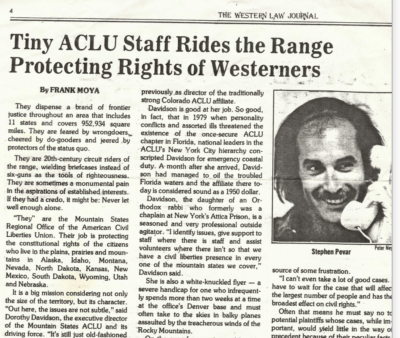
A newspaper clipping from the 1970s titled

What was your first case? What are some of your most memorable cases?

My first ACLU case was a racial justice case. Two months after I started my job, I filed a Title VIII housing discrimination case in Minot, North Dakota on behalf of a Black woman denied housing on the basis of race. The defendants settled the case and our client received damages.

A few months later, I filed two more cases, both totally different from the first case and from each other. One of them, U.S. ex rel. Means v. Solem, was a free speech case on behalf of Indian activist Russell Means. The issue was whether he had a free speech right to engage in a political demonstration despite being on bail. The court ruled in our favor. In the other, Cardiff v. Bismarck Pub. Sch. Dist., the North Dakota Supreme Court held that a “free public education” as guaranteed in the state constitution prohibited a school district from charging parents for their children’s school books. Both cases established important principles in two different states involving key civil liberties issues (freedom of speech, and access to a free and equal education).

Can you name a few of your most significant wins?

I had more than 100 wins that I consider significant. In fact, more than 100 of my cases resulted in reported decisions. As the only ACLU attorney in 11 states, I was very selective (and turned down 500 cases for every one I took). The ones I took were significant.

I also handled intake from those 11 states. I received hundreds of letters every year seeking ACLU assistance, and I answered all of them. In many instances, I sent letters to government officials on behalf of the client when litigation wasn’t possible for our office. Much of what I accomplished was as a result of those letters, in addition to my litigation.

Also, I sued nearly a third of the jails in Wyoming and in Idaho. Many counties in those states opted to improve their jails, rather than be sued and pay attorneys’ fees. These lawsuits resulted in an overhaul of the jail system in those states. Similarly, I sued school districts in Idaho to half the practice of distributing bibles to students and, after winning the first several cases, the practice came to a halt. As for individual cases, here are a few:

● Board of Pardons v. Allen (1987): This was the one case I argued in the Supreme Court. The court ruled in our favor, holding that a Montana parole statute created a protected liberty interest in release on parole and, therefore, prisoners denied parole must be notified of the reasons they were denied.

● Missouri Knights of the KKK v. Kansas City (1989): In this case, the court ruled that the KKK had a free speech right to appear on a municipal public access cable channel on the same basis as everyone else. When Caroline Kennedy and Ellen Alderman wrote “In Our Defense: The Bill of Rights in Action” in 1992, they featured this case and discussed my role in it.

● Ridgeway v. Montana High School Athletic Ass’n. (1990): This was the first statewide class action Title IX case that sought (and obtained) substantial equality in high school athletics for girls. This case changed high school athletic programs throughout the state and guaranteed parity.

● Spiering v. City of Madison (1994): Tom Spiering was a career law enforcement officer who was fired after he blew the whistle on a corrupt supervisor. After a four-day trial, the court found in his favor on free speech grounds. In an earlier free speech case in the same court, Wolf v. City of Aberdeen, the court found that five employees of the city’s fire department had been punished in violation of the First Amendment for speaking on a matter of public concern.

● Yellowbear v. Lampert (2014) and Miller v. Murphy (2008): Both cases were filed against officials at the Wyoming State Penitentiary and both were settled favorably. In Yellowbear, we obtained a consent decree requiring prison officials to allow a Native American religious adherent to possess up to four eagle feathers in his cell for use in religious ceremonies. In Miller, we obtained a consent decree requiring prison officials to accommodate the needs of Muslim prisoners to Halal meals and to pray at certain times without forfeiting their meals.

● Oglala Sioux Tribe v. Van Hunnik (2015): In this case, the district court found that state welfare officials had repeatedly violated the Indian Child Welfare Act and the Due Process Clause, resulting in the unlawful removal of 823 American Indian children from their families, and ordered systemic changes. The remedial order was reversed on appeal, however, on abstention grounds. Despite the reversal, state welfare officials continue to implement all of the procedures that the district court held were required by federal law.
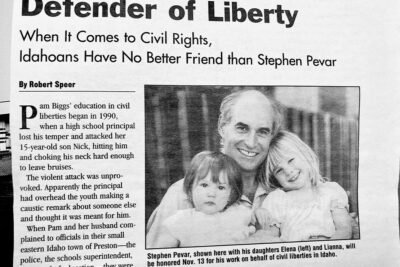
Stephen Pevar together with his daughters as toddlers.

How have you seen the ACLU evolve during your 45-year career?

By far the greatest evolution is one of size. The ACLU is probably 50 times larger than when I started working here, both at national and in the affiliates. As a result, we can undertake far more work than we previously could. Another evolution is that the ACLU has become a mainstream and well-known organization, generally respected even by those who disagree with us. That wasn’t the case when I started. At first, few people knew about the ACLU and many who did, despised us. Lastly, the ACLU now litigates in many areas we didn’t previously (or didn’t do nearly as much as today).

What do you see the ACLU looking like in the next 45 years? What works lies ahead?

I hope the ACLU continues to grow at the same rate we have grown during the past 45 years, and that we continue to take many types of cases. One type of case we need to undertake far more frequently than we do is Indigenous justice cases. I would like to see us do far more work in this area.

Stay informed about our work
Sign up

Published May 7, 2022 at 02:55AM
via ACLU https://ift.tt/8Cm2XyS

ACLU: 45 Years of Defending Liberty

45 Years of Defending Liberty

When Stephen Pevar joined the ACLU in 1976, he was one of only 15 national staff attorneys. Over the next 45 years, he filed more than 175 cases — winning or settling more than 90 percent of them — as the organization expanded to a workforce that spans every state, Washington D.C., and Puerto Rico, with more than 75 staff attorneys at the national office alone. Last month, he retired as one of the ACLU’s longest-serving staff members.

Following his departure, we sat down with Stephen to discuss big wins and memorable moments from his decades-long career — almost half the ACLU’s 102-year existence — spearheading our Indigenous justice work across the country.

How did you get your start as an ACLU attorney?

My legal career began in 1971 as a Legal Aid attorney on the Rosebud Sioux Indian Reservation in South Dakota, where I worked for nearly four years. During that time, I was selected by the ACLU to become a member of the ACLU’s Indian Rights Committee (IRC), which had just been formed to develop a proposed policy for the ACLU on tribal rights. I got to know the ACLU and the ACLU got to know me from my work on the IRC. When a position in the Mountain States Offices (MSO) opened in 1976, I applied for it and was hired. At the MSO, I was the only staff attorney — national or affiliate — in an 11-state region. It was a great job because I was able to take a lot of different cases in those 11 states. In 2000, the national office closed the MSO because all 11 states now had staff attorneys, and I soon joined the newly-created Racial Justice Program at national as a staff attorney under the leadership of Dennis Parker.

What issues have you worked on?

I’ve worked on a huge range of issues, including free speech, separation of church and state, prisoners’ rights, voting rights, Indigenous justice, and Title IX parity, among others.

A newspaper clipping from the 1970s titled

What was your first case? What are some of your most memorable cases?

My first ACLU case was a racial justice case. Two months after I started my job, I filed a Title VIII housing discrimination case in Minot, North Dakota on behalf of a Black woman denied housing on the basis of race. The defendants settled the case and our client received damages.

A few months later, I filed two more cases, both totally different from the first case and from each other. One of them, U.S. ex rel. Means v. Solem, was a free speech case on behalf of Indian activist Russell Means. The issue was whether he had a free speech right to engage in a political demonstration despite being on bail. The court ruled in our favor. In the other, Cardiff v. Bismarck Pub. Sch. Dist., the North Dakota Supreme Court held that a “free public education” as guaranteed in the state constitution prohibited a school district from charging parents for their children’s school books. Both cases established important principles in two different states involving key civil liberties issues (freedom of speech, and access to a free and equal education).

Can you name a few of your most significant wins?

I had more than 100 wins that I consider significant. In fact, more than 100 of my cases resulted in reported decisions. As the only ACLU attorney in 11 states, I was very selective (and turned down 500 cases for every one I took). The ones I took were significant.

I also handled intake from those 11 states. I received hundreds of letters every year seeking ACLU assistance, and I answered all of them. In many instances, I sent letters to government officials on behalf of the client when litigation wasn’t possible for our office. Much of what I accomplished was as a result of those letters, in addition to my litigation.

Also, I sued nearly a third of the jails in Wyoming and in Idaho. Many counties in those states opted to improve their jails, rather than be sued and pay attorneys’ fees. These lawsuits resulted in an overhaul of the jail system in those states. Similarly, I sued school districts in Idaho to half the practice of distributing bibles to students and, after winning the first several cases, the practice came to a halt. As for individual cases, here are a few:

● Board of Pardons v. Allen (1987): This was the one case I argued in the Supreme Court. The court ruled in our favor, holding that a Montana parole statute created a protected liberty interest in release on parole and, therefore, prisoners denied parole must be notified of the reasons they were denied.

● Missouri Knights of the KKK v. Kansas City (1989): In this case, the court ruled that the KKK had a free speech right to appear on a municipal public access cable channel on the same basis as everyone else. When Caroline Kennedy and Ellen Alderman wrote “In Our Defense: The Bill of Rights in Action” in 1992, they featured this case and discussed my role in it.

● Ridgeway v. Montana High School Athletic Ass’n. (1990): This was the first statewide class action Title IX case that sought (and obtained) substantial equality in high school athletics for girls. This case changed high school athletic programs throughout the state and guaranteed parity.

● Spiering v. City of Madison (1994): Tom Spiering was a career law enforcement officer who was fired after he blew the whistle on a corrupt supervisor. After a four-day trial, the court found in his favor on free speech grounds. In an earlier free speech case in the same court, Wolf v. City of Aberdeen, the court found that five employees of the city’s fire department had been punished in violation of the First Amendment for speaking on a matter of public concern.

● Yellowbear v. Lampert (2014) and Miller v. Murphy (2008): Both cases were filed against officials at the Wyoming State Penitentiary and both were settled favorably. In Yellowbear, we obtained a consent decree requiring prison officials to allow a Native American religious adherent to possess up to four eagle feathers in his cell for use in religious ceremonies. In Miller, we obtained a consent decree requiring prison officials to accommodate the needs of Muslim prisoners to Halal meals and to pray at certain times without forfeiting their meals.

● Oglala Sioux Tribe v. Van Hunnik (2015): In this case, the district court found that state welfare officials had repeatedly violated the Indian Child Welfare Act and the Due Process Clause, resulting in the unlawful removal of 823 American Indian children from their families, and ordered systemic changes. The remedial order was reversed on appeal, however, on abstention grounds. Despite the reversal, state welfare officials continue to implement all of the procedures that the district court held were required by federal law.

Stephen Pevar together with his daughters as toddlers.

How have you seen the ACLU evolve during your 45-year career?

By far the greatest evolution is one of size. The ACLU is probably 50 times larger than when I started working here, both at national and in the affiliates. As a result, we can undertake far more work than we previously could. Another evolution is that the ACLU has become a mainstream and well-known organization, generally respected even by those who disagree with us. That wasn’t the case when I started. At first, few people knew about the ACLU and many who did, despised us. Lastly, the ACLU now litigates in many areas we didn’t previously (or didn’t do nearly as much as today).

What do you see the ACLU looking like in the next 45 years? What works lies ahead?

I hope the ACLU continues to grow at the same rate we have grown during the past 45 years, and that we continue to take many types of cases. One type of case we need to undertake far more frequently than we do is Indigenous justice cases. I would like to see us do far more work in this area.

Stay informed about our work
Sign up

Published May 6, 2022 at 10:25PM
via ACLU https://ift.tt/8Cm2XyS

Wednesday, 4 May 2022

ACLU: What to Know About the Leaked Supreme Court Abortion Draft Opinion, and What’s Next

What to Know About the Leaked Supreme Court Abortion Draft Opinion, and What’s Next

On Monday night, Politico published a leaked draft of the highly anticipated Supreme Court opinion in Dobbs v. Jackson Women’s Health Organization. The draft majority opinion, penned by Justice Samuel Alito, overturns the landmark Roe v. Wade decision, which has been on the books for nearly 50 years and has ensured abortion is a protected federal constitutional right. If this draft decision is issued as the official decision, it would be unprecedented and would take away a fundamental right for millions of people, and the language used calls into question far more than abortion access. For now, this is just a draft opinion, and the actual Supreme Court decision is expected by the end of June.

Brigitte Amiri, deputy director of the ACLU Reproductive Freedom Project, joined us on At Liberty to break down the nuts and bolts of this opinion and what lies ahead. This is a condensed version of that conversation, and you can listen to the full version here.

https://soundcloud.com/aclu/special-edition-strategies-for-the-end-of-roe

ACLU: This draft opinion sent shockwaves throughout the country. Can you bring us up to speed on what our readers should know about the leak? How did you react when you first read it?

Brigitte Amiri: The draft opinion essentially says that the Constitution no longer protects abortion, and if it is adopted as the official court opinion, the consequences will be devastating. If this opinion is issued by the court, abortion will be banned in about half the states. When it first hit the airwaves, I was in disbelief, and I was skeptical of whether it was authentic or not. But we have been preparing for the possibility that the Supreme Court could overturn Roe just based on the questions that the justices asked in this case during oral arguments. So in that sense, it’s not a total shock that this is possibly where the court is going.

ACLU: Before we get into the details about the opinion, let’s reiterate that this is just a draft. How can people support folks who need access to abortion care now?

BA: Yes, it’s just a draft; this isn’t an opinion. People who have abortion appointments scheduled today should go to their appointments and call your local clinic if you have questions. This doesn’t change the law now. If you want to express your support, I would say tap into your local reproductive rights, justice, and health community and find out how you can be involved. Donate to your local abortion fund, and to practical support organizations that make sure people can access care. These are all critically important parts of the infrastructure that exist to make sure people can get care, and that infrastructure needs to be invested in. You can also contact your local representatives, and your senators. This is the time to let elected officials know where you stand on this issue and how important it is to you.

ACLU: Back to the draft opinion: Let’s recap ​​Dobbs. Where did the case originate, and what did the oral arguments in December hint about what was to come?

BA: This case was brought by our friends at the Center for Reproductive Rights — they represent the last abortion clinic in Mississippi. The case centered around whether the state can ban abortion after the first 15 weeks of pregnancy. The State of Mississippi asked the court not just to uphold the 15-week ban, but to consider the constitutionality of abortion in general, and whether the Constitution protects abortion at all. That was a direct invitation from the state to overturn Roe and Planned Parenthood v. Casey.

The Supreme Court’s choice to even consider this very broad question that has been settled for decades was really disconcerting.

ACLU: If the draft opinion is adopted by the court, what happens next?

BA: Roughly half of the states will ban abortion almost immediately, and half the states will continue to allow abortion. But it’s important to understand that the long-term agenda of abortion opponents doesn’t end with overturning Roe. What they want is a nationwide ban on abortion. So if you’re in a state like New York or California, where you believe you will have access to abortion even if Roe is overturned, that is true in the short term. But the plan from abortion opponents is to continue to push for a nationwide ban, so that could change.

ACLU: What is the ACLU doing, and what will we do if Roe is indeed overturned?

BA: On the litigation side, we’ve been holding the line in the states where we can by bringing defensive cases. But the federal courts are becoming more and more hostile, and if we lose the federal constitutional right to abortion entirely, these courts will not be the avenue to protect abortion. But we’re also working at the policy level in the states, where legislation is moving to protect access in states that don’t have abortion restrictions, so that people who travel to those states are able to get care quickly, easily, without hurdles and without obstacles. We’re also working on telehealth, and removing restrictions on access to medication abortion. We’re looking to state constitutions, some of which provide greater protection for abortion access than the federal Constitution.

ACLU: In Alito’s draft opinion, he writes that Roe was wrong from the start, saying that it has nothing to do with the original intent of the Constitution. Aren’t there many other examples of landmark decisions from the Supreme Court that don’t arise from the original context within which the Constitution was written? What else will be impacted if we go down this path?

BA: If this is really where the Supreme Court is headed — that you only have a constitutional right if it was contemplated by white men in the 1700s — then there’s a whole host of issues that we work on here and that people care about in our country that are at risk, like access to contraception and LGBTQ rights. These are rights that will most directly impact women, people of color, and the LGBTQ community. And we’ve already seen legislators talking about how Griswold v. Connecticut should be overturned — that’s the case that provides constitutional protection for the right to access contraception. Arguments about privacy in Griswold paved the way for same-sex marriage.These cases are interconnected, so all of these rights are implicated.

ACLU: Justice Alito also refers to a 13th Century treatise that designates abortion as homicide, and relies on medieval common law in which women are likened to chattel. Although some of this language may be softened before the final opinion does come out, it is hard not to see this as a window into the logic of a sitting justice that has a lot of power and is in the majority. How do we move forward while knowing that these are the perspectives of an institution that deems itself nonpolitical?

BA: Right, so we know these are Justice Alito’s views, and maybe this is ultimately written as a concurrence, rather than the majority opinion. But it is really terrifying that someone who is so powerful holds these views about people’s roles in society and women’s roles in society. So, how do we move forward? It’s not going to be the courts that are going to make the change. We’ve been able to stop a lot of really bad things from happening through our litigation. But in order to create long-standing, really fundamental change, it’s going to look different. We need to be looking to people who are organizing within the ACLU, our affiliates, and their coalitions on the ground, and looking to the local reproductive justice and health organizations that are already doing this work. Roe didn’t mean that all people had abortion access, and there were already people living in parts of the country without it. So as devastating as this moment is, we need to take it and really think about our vision. What do we want? Not just access to abortion and contraception for all, but also the ability to have children and to parent in the way that people see fit in a world free from police violence, and with infrastructure in our communities to care for those children. This is something that we all should be thinking about, and we really are not looking to the courts to make that change. We have to look within our communities and think about the long-term sustainability of reproductive freedom in this country.

ACLU: What can people do now to support your work, the work of your colleagues, and abortion access more broadly?

BA: We have actions on our website that people can take on all of these issues. Check out your local ACLU, and check out your local reproductive rights and justice organizations to see how you can get involved, how you can support abortion funds, how you can volunteer at the local clinic. What’s also incredibly important right now are voting rights. The vast majority of people in this country support access to abortion. But because of the diminished power in people’s votes through gerrymandering and other voting restrictions, the scaling back of the Voting Rights Act, the work that our colleagues are doing in the voting rights arena is also critically important. The right to vote has been so watered down because of all of the restrictions that have been put in place, and that we’re fighting against as well. So all of these issues that we work on at the ACLU are very connected. For any piece of this that people are interested in, there’s a way to get involved.

What you can do:
Defend Abortion Access for All
Send your message


Published May 4, 2022 at 11:59PM
via ACLU https://ift.tt/YpGnK37

ACLU: What to Know About the Leaked Supreme Court Abortion Draft Opinion, and What’s Next

What to Know About the Leaked Supreme Court Abortion Draft Opinion, and What’s Next

On Monday night, Politico published a leaked draft of the highly anticipated Supreme Court opinion in Dobbs v. Jackson Women’s Health Organization. The draft majority opinion, penned by Justice Samuel Alito, overturns the landmark Roe v. Wade decision, which has been on the books for nearly 50 years and has ensured abortion is a protected federal constitutional right. If this draft decision is issued as the official decision, it would be unprecedented and would take away a fundamental right for millions of people, and the language used calls into question far more than abortion access. For now, this is just a draft opinion, and the actual Supreme Court decision is expected by the end of June.

Brigitte Amiri, deputy director of the ACLU Reproductive Freedom Project, joined us on At Liberty to break down the nuts and bolts of this opinion and what lies ahead. This is a condensed version of that conversation, and you can listen to the full version here.

https://soundcloud.com/aclu/special-edition-strategies-for-the-end-of-roe

ACLU: This draft opinion sent shockwaves throughout the country. Can you bring us up to speed on what our readers should know about the leak? How did you react when you first read it?

Brigitte Amiri: The draft opinion essentially says that the Constitution no longer protects abortion, and if it is adopted as the official court opinion, the consequences will be devastating. If this opinion is issued by the court, abortion will be banned in about half the states. When it first hit the airwaves, I was in disbelief, and I was skeptical of whether it was authentic or not. But we have been preparing for the possibility that the Supreme Court could overturn Roe just based on the questions that the justices asked in this case during oral arguments. So in that sense, it’s not a total shock that this is possibly where the court is going.

ACLU: Before we get into the details about the opinion, let’s reiterate that this is just a draft. How can people support folks who need access to abortion care now?

BA: Yes, it’s just a draft; this isn’t an opinion. People who have abortion appointments scheduled today should go to their appointments and call your local clinic if you have questions. This doesn’t change the law now. If you want to express your support, I would say tap into your local reproductive rights, justice, and health community and find out how you can be involved. Donate to your local abortion fund, and to practical support organizations that make sure people can access care. These are all critically important parts of the infrastructure that exist to make sure people can get care, and that infrastructure needs to be invested in. You can also contact your local representatives, and your senators. This is the time to let elected officials know where you stand on this issue and how important it is to you.

ACLU: Back to the draft opinion: Let’s recap ​​Dobbs. Where did the case originate, and what did the oral arguments in December hint about what was to come?

BA: This case was brought by our friends at the Center for Reproductive Rights — they represent the last abortion clinic in Mississippi. The case centered around whether the state can ban abortion after the first 15 weeks of pregnancy. The State of Mississippi asked the court not just to uphold the 15-week ban, but to consider the constitutionality of abortion in general, and whether the Constitution protects abortion at all. That was a direct invitation from the state to overturn Roe and Planned Parenthood v. Casey.

The Supreme Court’s choice to even consider this very broad question that has been settled for decades was really disconcerting.

ACLU: If the draft opinion is adopted by the court, what happens next?

BA: Roughly half of the states will ban abortion almost immediately, and half the states will continue to allow abortion. But it’s important to understand that the long-term agenda of abortion opponents doesn’t end with overturning Roe. What they want is a nationwide ban on abortion. So if you’re in a state like New York or California, where you believe you will have access to abortion even if Roe is overturned, that is true in the short term. But the plan from abortion opponents is to continue to push for a nationwide ban, so that could change.

ACLU: What is the ACLU doing, and what will we do if Roe is indeed overturned?

BA: On the litigation side, we’ve been holding the line in the states where we can by bringing defensive cases. But the federal courts are becoming more and more hostile, and if we lose the federal constitutional right to abortion entirely, these courts will not be the avenue to protect abortion. But we’re also working at the policy level in the states, where legislation is moving to protect access in states that don’t have abortion restrictions, so that people who travel to those states are able to get care quickly, easily, without hurdles and without obstacles. We’re also working on telehealth, and removing restrictions on access to medication abortion. We’re looking to state constitutions, some of which provide greater protection for abortion access than the federal Constitution.

ACLU: In Alito’s draft opinion, he writes that Roe was wrong from the start, saying that it has nothing to do with the original intent of the Constitution. Aren’t there many other examples of landmark decisions from the Supreme Court that don’t arise from the original context within which the Constitution was written? What else will be impacted if we go down this path?

BA: If this is really where the Supreme Court is headed — that you only have a constitutional right if it was contemplated by white men in the 1700s — then there’s a whole host of issues that we work on here and that people care about in our country that are at risk, like access to contraception and LGBTQ rights. These are rights that will most directly impact women, people of color, and the LGBTQ community. And we’ve already seen legislators talking about how Griswold v. Connecticut should be overturned — that’s the case that provides constitutional protection for the right to access contraception. Arguments about privacy in Griswold paved the way for same-sex marriage.These cases are interconnected, so all of these rights are implicated.

ACLU: Justice Alito also refers to a 13th Century treatise that designates abortion as homicide, and relies on medieval common law in which women are likened to chattel. Although some of this language may be softened before the final opinion does come out, it is hard not to see this as a window into the logic of a sitting justice that has a lot of power and is in the majority. How do we move forward while knowing that these are the perspectives of an institution that deems itself nonpolitical?

BA: Right, so we know these are Justice Alito’s views, and maybe this is ultimately written as a concurrence, rather than the majority opinion. But it is really terrifying that someone who is so powerful holds these views about people’s roles in society and women’s roles in society. So, how do we move forward? It’s not going to be the courts that are going to make the change. We’ve been able to stop a lot of really bad things from happening through our litigation. But in order to create long-standing, really fundamental change, it’s going to look different. We need to be looking to people who are organizing within the ACLU, our affiliates, and their coalitions on the ground, and looking to the local reproductive justice and health organizations that are already doing this work. Roe didn’t mean that all people had abortion access, and there were already people living in parts of the country without it. So as devastating as this moment is, we need to take it and really think about our vision. What do we want? Not just access to abortion and contraception for all, but also the ability to have children and to parent in the way that people see fit in a world free from police violence, and with infrastructure in our communities to care for those children. This is something that we all should be thinking about, and we really are not looking to the courts to make that change. We have to look within our communities and think about the long-term sustainability of reproductive freedom in this country.

ACLU: What can people do now to support your work, the work of your colleagues, and abortion access more broadly?

BA: We have actions on our website that people can take on all of these issues. Check out your local ACLU, and check out your local reproductive rights and justice organizations to see how you can get involved, how you can support abortion funds, how you can volunteer at the local clinic. What’s also incredibly important right now are voting rights. The vast majority of people in this country support access to abortion. But because of the diminished power in people’s votes through gerrymandering and other voting restrictions, the scaling back of the Voting Rights Act, the work that our colleagues are doing in the voting rights arena is also critically important. The right to vote has been so watered down because of all of the restrictions that have been put in place, and that we’re fighting against as well. So all of these issues that we work on at the ACLU are very connected. For any piece of this that people are interested in, there’s a way to get involved.

What you can do:
Defend Abortion Access for All
Send your message


Published May 4, 2022 at 07:29PM
via ACLU https://ift.tt/YpGnK37

Tuesday, 3 May 2022

Monday, 2 May 2022