New York's Coercion of Private Companies to Blacklist the NRA Has a Long and Dark History
More than 60 years ago the Supreme Court ruled that the First Amendment bars the government from coercing private entities to punish speech that the government disfavors. Just as the government can’t directly punish or censor speech it disagrees with, it cannot do so indirectly by coercing private parties to do the same.
History underscores the importance of this free speech protection. Government officials have all too often enlisted private parties—from the White Citizens’ Councils of the Jim Crow South to the blacklists of Communists in the McCarthy era—to punish those with whom they disagree. New York’s efforts to punish the National Rifle Association, at issue before the Supreme Court in National Rifle Association v. Vullo, follow in the footsteps of those earlier censorship efforts.
The ACLU disagrees sharply with the NRA on many issues, yet we are representing the group in this case because of the First Amendment principles at stake.
The ACLU disagrees sharply with the NRA on many issues, yet we are representing the group in this case because of the First Amendment principles at stake. We argue that Maria Vullo, a New York state regulator, threatened to use her regulatory power over banks and insurance companies to coerce them into denying basic financial services to the NRA and, in Vullo’s own words, “other gun promotion” groups. Vullo’s threats were expressly based on her disagreement with the NRA’s advocacy. And they worked. Several insurance companies and banks refused to work with the NRA out of fear of reprisals from New York regulators. The ACLU urges the Supreme Court to hold that coercing third parties to break ties with the NRA because of its advocacy violates the First Amendment.
Even those who oppose government censorship may be sympathetic to New York’s efforts to shut down the NRA. The NRA is dedicated to promoting guns, which play an outsized role in violence and death in this country. The ACLU does not support the NRA’s mission. In fact, we directly oppose the NRA and support the government’s power to adopt sensible tools, like public carry permits and disarming persons subject to domestic violence protective orders. While it’s understandable that Vullo wanted to address the gun violence epidemic, government censorship wasn’t a constitutional response to the problem.
The right to advocate views the government opposes safeguards our ability to organize for the country we want to see.
The NRA’s case is hardly the first time government officials have sought to use private parties to penalize those with whom they disagree. Our nation’s history is replete with examples. And when the government threatens businesses in this way, the businesses often go along. As summed up by a slogan during the McCarthy Era: “Why buy yourself a headache?”
During the McCarthy era, from the late 1940s to 60s, the government regularly pressured private entities to fire people it perceived as connected with the Communist Party. The FBI and the House Committee on Un-American Activities delivered the names of employees who had alleged connections to “subversive” organizations, or even subscriptions to their publications, to private employers like defense contractors, universities, newspapers, and major corporations such as General Electric and U.S. Steel. Employers that failed to fire these employees faced loss of lucrative government contracts, necessary licenses, targeted investigations, and public smearing.
The ACLU itself has been the target of such efforts. In the late 1930s, Jersey City Mayor Frank Hague bragged that the reason the ACLU and the Congress of Industrial Organizations (CIO) had been unable to book a single private hall for meetings or speakers was because the hall owners are his “friends” and knew that he did “not approve of un-American groups coming into Jersey City.” The one hall owner who did rent his hall to the CIO for a meeting was then charged with a building violation. When asked about the violation at trial, Hague responded “Any port in a storm, Counselor”—effectively acknowledging that the violation was in retaliation for renting the private hall to a disfavored speaker.
The ACLU’s predecessor, the National Civil Liberties Bureau, confronted similar efforts during World War I. When the Justice Department attempted to put the Industrial Workers of the World (IWW) out of business by filing criminal charges against more than 100 members who had called for labor strikes, accusing them of undermining the war effort, the National Civil Liberties Bureau placed an advertisement seeking funds for the IWW’s “right of a fair trial.” The government responded by coercing The New Republic, a privately-run media company, to support its goal by threatening to revoke the magazine’s second-class mailing privileges if it reprinted the message.
Southern states turned to this tactic in their resistance to racial integration established in Brown v. Board of Education. Some states mandated public disclosure of the National Association for the Advancement of Colored People’s (NAACP) members, and relied on private entities that shared the state’s commitment to maintaining white supremacy, such as the White Citizens’ Councils, to publicize the disclosures to private business owners who were expected to then punish those named. As a result, NAACP members were fired, denied credit, prohibited from purchasing goods, evicted or had their home loans foreclosed, and subjected to threats of and actual violence. This public-private partnership became a blueprint for how to use racialized violence as an “economic cold war” to render both Black and white supporters of the NAACP “destitute” and undermine their ability to advocate for racial justice.
Nor is this tactic a relic of the past. In Florida, Gov. Ron DeSantis directed the state agency in charge of liquor licensing to see if it could stop private entities hosting performances of “A Drag Queen Christmas.” After the shows went forward, a non-profit theater venue in Orlando and the Hyatt Regency Miami faced actions to revoke their liquor licenses for allegedly violating laws prohibiting lewdness, vulgar exposure of sexual organs, and obscene performances—despite the agency’s own undercover agents attending and reporting that there were no “lewd acts” or “exposure of genital organs.”
Maria Vullo followed the same playbook. As the state’s top financial regulator, in coordination with then-Governor Andrew Cuomo, she expressly targeted the NRA for its “gun promotion” advocacy and urged all the banks and insurance companies she regulates to refuse to do business with the NRA. She offered leniency to one insurer for legal infractions if it would cut its ties to the NRA, and extracted promises from the NRA’s three largest insurance partners never to provide “affinity insurance” to the group’s members ever again.
NRA v. Vullo isn’t just about the NRA. It’s about all of our First Amendment rights to advocate for causes we believe in, without being targeted by public-private ventures of retaliation. If New York can do this to the NRA, then Oklahoma could similarly penalize criminal justice reformers advocating for bail reform, and Texas could target climate change organizations advancing the view that all fossil fuel extraction must end. The right to advocate views the government opposes safeguards our ability to organize for the country we want to see. It’s a principle the ACLU has defended for more than 100 years, and one we will continue to protect from government censorship of all kinds, whether we agree or disagree with the views of those being targeted.
Reflecting on the Abortion Criminal Defense Initiative’s First Year
As we mark the one-year anniversary of the launch of the Abortion Criminal Defense Initiative (ACDI), we are reflecting on the groundbreaking strides we’ve made in coalition with our partners, and the critical work ahead in the fight against the use of the carceral state to chill access to abortion care. In a year filled with legal uncertainties and fear, we’ve been honored to fight against the harms of abortion criminalization on behalf of abortion providers, patients, and supporters. By engaging with local defenders, health care workers, advocates, lawyers, and community supporters, we are following the lead of those closest to the carceral state’s harms who have the most insight on how to best address the needs of people who are directly impacted. Inspired by the commitment of our partners and led by the needs of our clients, we’re not backing down. Looking back at the past year, we’re humbled by the progress we’re making, and committed to building on it to support those in need.
Over the last year, we established a network of over 100 experienced, values-aligned criminal defense attorneys who are prepared to defend folks facing criminal investigations or prosecutions related to abortion care. The ACDI Attorney Network includes former public defenders and prosecutors, sole practitioners and law firm partners, trial and appellate litigators, and experts in both state and federal defense, who stand ready in every state where abortion access is banned or severely restricted. Together, we are prepared for whatever challenges may lie ahead.
We are Supporting Individuals who Need Legal Assistance
As part of the Abortion Defense Network, the ACLU responded to requests from individuals across the country for assistance with abortion-related criminal defense needs. By partnering these people with experienced criminal defense attorneys and support, we’re helping folks navigate the legal system and mitigate the harms posed by the criminalization of abortion care. In the face of continuing threats of prosecution, we will continue to work tirelessly to ensure that those with abortion-related criminal defense needs are not alone.
We are Empowering Abortion Providers and Helpers
The ACLU is committed to ensuring that those at risk of criminalization know how to protect themselves in the event of a criminal investigation and feel empowered to do so. Through arming providers and helpers with information on how to assert their constitutional rights, these preventive measures help protect against government overreach from the outset. We’ve developed Know Your Rights resources and partnered with local and national movement partners to provide trainings tailored to health care workers and abortion supporters. We are excited to continue this work in the year ahead.
We are incredibly proud of what we’re building and are humbled to work alongside providers, organizations, and attorneys who are fighting back against abortion criminalization. The victories achieved over the past year demonstrate the power of collective action and the resilience of those committed to ensuring continued access to abortion care for all.
4 Ways the ACLU Continues to Fight for Gender Equality
In 1987, 15 years after the Women’s Rights Project was established at the ACLU, March was officially designated as Women’s History Month in the United States. This time is for the celebration of the women whose contributions and achievements have shaped our society. Such a celebration may feel painful at this moment, when we are facing the fall of Roe v. Wade, the Black maternal mortality crisis, as well as ongoing, systemic barriers including the gender wage gap, family policing, lack of affordable housing, and sexual harassment. Yet it is precisely at times like these we need reminders why we still fight – and that we still win. In the perpetual fight for justice and equity, women have not only been essential, but have also consistently led the way. Each March, we must celebrate the progress made, and acknowledge all the work that has been and has yet to be done.
For over 50 years, the ACLU’s Women’s Rights Project (WRP) has been at the forefront of the fight for gender justice. And just as Women’s History Month continues to evolve each year, our work has expanded and developed, with a focus on taking an intersectional approach. Here are four ways we continue to fight for equality:
1. Challenging Discriminatory Dress Codes
The ACLU has led the way in fighting discriminatory dress codes that reinforce sexist and racist stereotypes in schools and at work. These discriminatory codes target girls, people of color, and members of the LBGTQIA+ community, particularly girls who live at the intersection of those identities. Many students and workers across the county are subject to senseless, sex-based restrictions such as skirts, dresses, and “modest clothing” for women and girls and short hair, pants, and no accessories for men and boys. We successfully challenged a charter school’s “skirts only” rule for girls, which the school adopted based on the belief that every girl is a “fragile vessel.” The school sought to overturn the decision but, in 2023, the Supreme Court left the victory in place. This past year, we also reached a historic settlement with Alaska Airlines to remove all gendered restrictions from its uniform policy for flight attendants.
Across the country, we’ve sought to end the enforcement of discriminatory dress codes in a range of other contexts as well. We’ve fought to end discriminatory dress codes in schools that prevent boys and non-binary students from wearing their hair long, which prevents Native American and Black students, among others, from expressing their cultural and religious traditions. We’ve also worked to end dress codes that penalize student athletes on the girls’ cross-country teams for training in weather-appropriate clothing, as well as those that forbid transgender seniors from attending their high school graduation dressed as themselves.
2. Taking on Housing Policies that Blacklist Black and Brown Women
In our fight for housing justice, we have taken on “No-Eviction” policies and other screening policies that disproportionately discriminate against Black renters, particularly Black women. These screening policies block potential renters from housing simply because they are connected to any previous eviction case, even if the case was very old, they ultimately won it, or the legal action against them was unlawfully filed in the first place. Black women are significantly more likely to have eviction cases filed against them by landlords, so these policies in turn impact and destabilize Black women, further perpetuating systemic inequality and segregation. In 2023, we filed two challenges against the use of these screening policies by Chicago-area landlords. These cases were among the first of their kind in the United States and aim to set a precedent for disrupting discriminatory housing practices.
3. Advocating for Pregnant and Lactating Workers
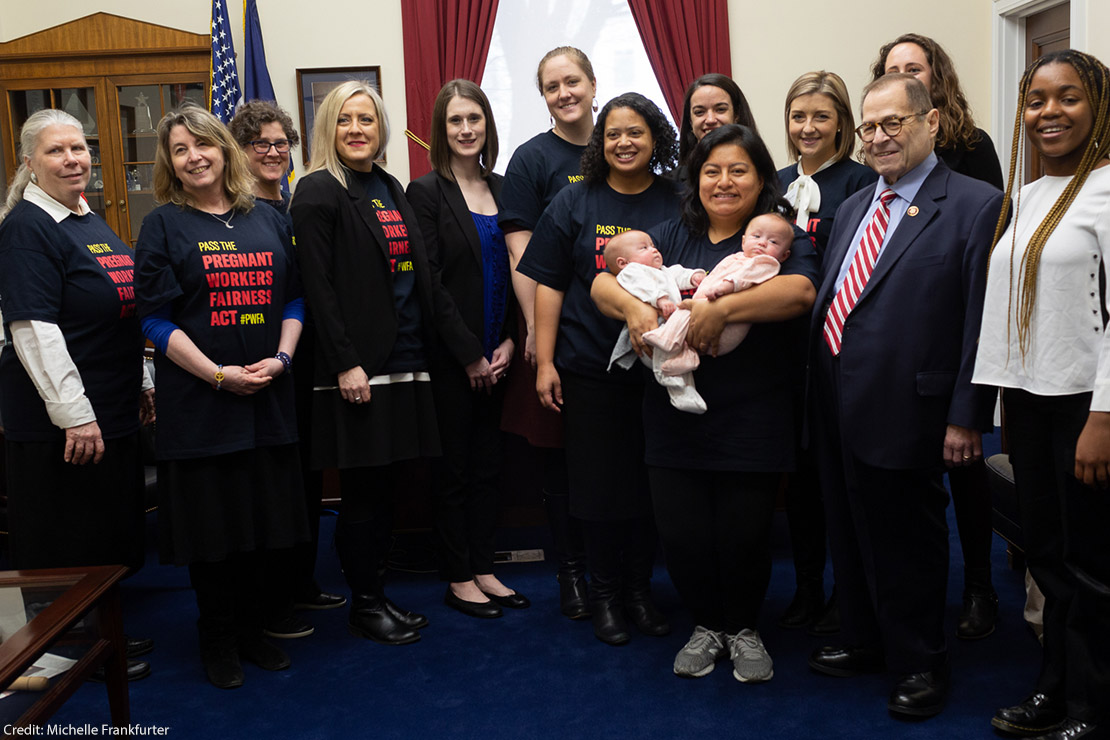
We have long been at the forefront of fighting for the rights of pregnant and breastfeeding workers who experience discrimination in the workplace. Over the past few years, the ACLU was a key advocate for the enactment of the Pregnant Workers Fairness Act and the PUMP for Nursing Mothers Act. These new landmark laws ensure that millions of pregnant and lactating workers have access to reasonable accommodations that allow them to continue working, instead of forcing them to choose between their paycheck and a healthy pregnancy and nursing period. We continue to litigate on behalf of employees who are denied pregnancy-related accommodations and those discriminated against for being pregnant.
4. Fighting the Separation of Black and Brown Families
As part of our work on behalf of families of color who are disproportionately impacted by the child welfare system, we have been a strong voice in raising awareness about the widespread use of automated tools by local governments to determine which families to investigate – tools that often heighten the risk of disintegration for Black and Brown families in the United States. In 2023, the ACLU published a report on the discriminatory effects of Allegheny County’s “Family Screening Tool,” which could disproportionately flag family members who were Black or had disabilities for investigation. The ACLU’s report prompted in-depth reporting from the Associated Press and an investigation from the U.S. Department of Justice.
While there is still much work ahead of us, our recent victories give us hope for progress toward a more equitable world for everyone, regardless of gender. We will continue the fight for gender justice alongside everyone who has been and continues to be a part of the movement with us.
President Biden's Order to Ban Private Prisons Faces a Persistent Internal Challenge: The U.S. Marshals Service
At the onset of President Biden’s term, in January 2021, he issued an executive order to phase out the federal criminal system’s use of for-profit prisons. This was an important step toward stemming the flow of federal money to corporations that lock people up for profit. The executive order covered both the Federal Bureau of Prisons, which holds people convicted of crimes, and the U.S. Marshals Service, which holds people while they await trial or await transfer to a federal prison after sentencing. However, it left out the federal government’s heavy use of for-profit immigration detention facilities, which are rife with abuse, unsanitary conditions, and overcrowding.
The Bureau of Prisons followed the executive order and has closed all of its for-profit prisons. The Marshals Service has not. An ACLU analysis of documents produced in response to a Freedom of Information Act request shows that, despite the executive order, the Marshals Service continues to hold nearly a third of its entire detention population in for-profit facilities, totaling 20,000 people. It does this by exploiting two loopholes it has created that undermine the purpose of the executive order: to end prison profiteering.
First, the Marshals Service has obtained repeated waivers from the White House that allow it to ignore the executive order and keep five for-profit facilities open. The Marshals Service and White House have not publicized these waivers, and when internal government investigators asked for documentation of these waivers, they were “told that no such documentation existed.”
Second, the Marshals Service has determined that it can continue to pay corporations to operate detention facilities for profit, so long as it uses a city or county government as a middleman. Under this arrangement, known as a “pass-through” agreement, the Marshals Service pays a city or county government, which keeps a portion of the payment and passes along most of the payment to the corporation that runs the facility. An internal government investigation found that these agreements cost the Marshals Service more and provide less control and oversight over operations at its detention facilities.
By using these two loopholes to keep funneling money to corporations that profit from incarceration, the Marshals Service perpetuates the harm that these corporations cause. In the words of President Biden’s domestic policy advisor: “Private prisons profiteer off federal prisoners and are proven to be, or found to be by the Department of Justice inspector general, less safe for correctional officers and prisoners.”
A statistical analysis has shown that as states turn more to for-profit prisons, their incarceration rates increase. This should come as no surprise: for-profit prison companies use the taxpayer money they receive to lobby extensively for increased incarceration. The two largest for-profit prison companies spent $1.7 million and $1.3 million lobbying the federal government alone, with more money going to state lobbying. This does not include the for-profit prison industry’s significant donations to political campaigns and PACs. For example, these two companies each spent a quarter million on President Trump’s 2017 inauguration festivities, and one donated $225,000 to a pro-Trump super PAC.
Congress has taken notice. Nine senators wrote a letter to “express deep concern that the [Marshals Service] appears to be circumventing President Biden’s Executive Order.”
There are a few concrete steps that the Biden administration and the Marshals Service can take now to address these problems and plan for an orderly transition away from for-profit prison companies. First and foremost, they should work together to divert people away from pre-trial detention in a way that protects community safety and ensures people show up for their trials. With fewer people to detain, the Marshals Service will have less need to pay for-profit facilities.
The Biden administration and Marshals Service should also work to find viable alternatives to for-profit facilities for those who remain in detention, where people can be held near their families, friends, and lawyers. People have a right to confer with their attorney regularly to prepare a defense, and numerous studies show that proximity to loved ones and support networks supports better outcomes when people are released from custody.
As they do this, they should be transparent. The Marshals Service should publish its plan to close the five for-profit prisons with which it continues to directly contract. It should develop a plan to stop using pass-through intergovernmental agreements and publish a plan to phase out these detention facilities as well. Spending taxpayer dollars to enrich private corporations and shareholders who run facilities with abusive practices, poor medical care, and unsanitary conditions is a policy that harms incarcerated individuals and creates unsafe working conditions for correctional officers. The Biden administration has called for an end to this policy, it is past time for the Marshals Service to listen.