Thursday, 7 November 2024

ACLU: Donald Trump will return to the White House in January. The ACLU is ready.

Donald Trump will return to the White House in January. The ACLU is ready.

Today, as the nation prepares for the devastating onslaught of civil liberties abuses identified in our most recent analysis of Donald Trump’s policy proposals and rhetoric, the ACLU, too, is prepared.

Starting on day one, we’re ready to fight for our civil liberties and civil rights in the courts, in Congress, and in our communities. We did it during his first term – filing 434 legal actions against Trump while he was in office – and we’ll do it again.

We’ve done the work and, today, our track record shows that we know how to fight his attempts to restrict our civil liberties and civil rights. Here’s just a few highlights from our 400 plus legal actions to make that point:


Published November 8, 2024 at 12:21AM
via ACLU https://ift.tt/5mBvQac

Wednesday, 6 November 2024

ACLU: How the ACLU Will Fight Four More Years of Trump

How the ACLU Will Fight Four More Years of Trump

The results of the election are in: Donald Trump will be the 47th president of the United States.

Trump’s win comes after a campaign in which he consistently targeted immigrants, transgender youth, and other vulnerable communities with hateful rhetoric. He also threatened retribution against dissidents and political opponents.

I know that many of us fear what these results mean for our communities, our nation and ourselves. We know that a second Trump administration will be even more aggressive and effective than it was before — because Trump has repeatedly said so.

As outlined in Project 2025, under a second Trump administration, our federal government will deport immigrants in dragnet raids, target his political adversaries, spy on private citizens, promote discrimination against marginalized communities, and control what we can and can’t do with our bodies. This dystopian view of American life threatens our fundamental freedoms. We know from prior experience that our fear is real.

We also know that despair and resignation are not a strategy. At the ACLU, we’re choosing to channel our fear into action. Together, we are powerful enough to change the course of our nation’s history and defend our most fundamental rights and freedoms. That is why the ACLU has a concrete plan to fight back. When President-elect Trump comes for our communities, he’s gotta through all of us.

During Trump’s first term, the ACLU filed 434 legal challenges against his administration, successfully blocking some of Trump’s most egregious policies, like the Muslim ban and separating immigrant families. When Trump once again set his sights on the White House, the ACLU’s legal and advocacy experts drafted a roadmap to combat his administration head-on. On day one, we are prepared to:

  • Defend against the Trump administration’s unlawful mass deportation plan through coordinated action at all levels of government. We’ll also work with states and localities to protect residents to the full extent possible and ensure that a Trump administration can’t hijack state resources to carry out its draconian policies.
  • Provide legal defense to whistleblowers and critics who dare to stand up to Trump’s policies. We’ll also protect freedom of speech and the right to protest against Trump’s agenda.
  • Use the courts to affirm that LGBTQ people are protected from discrimination under federal law. We’ll fight to invalidate Trump administration policies that permit discrimination across the federal government, and to shut down the administration’s efforts to require discrimination at the state and local levels.
  • Challenge the Trump administration’s dangerous attacks on reproductive freedom, including any attempts to weaponize the Comstock Act to ban abortion nationwide or to take medication abortion off the shelves. We’ll also protect access to birth control and family planning services.

As soon as the 119th Congress is sworn in, we will urge members to use their constitutional powers to provide oversight, investigate wrongdoing, and reject restrictive executive branch policies. At the state level, we’ll work with lawmakers to build a firewall for freedom and enact laws that protect people from government abuse. In our communities, we’re working to educate people on what is at risk, what happens next, and how we can fight for our freedoms together.

This is my sixth presidential election as executive director at the ACLU and there is not a doubt in my mind that our organization is the best equipped to meet this moment. We have more than a century of experience in combating political repression, we have some of the nation’s best legal and political advocates, we have our nationwide network of ACLU affiliates, and we have all of you.

The Trump administration’s anti-liberty and fundamentally anti-American policies will be met with the full firepower of the ACLU, the might of our allies, and the commitment of the American people. Above all else, that gives me hope. The next four years will be challenging, but we’re ready to put up the fight of the century. You can count on it.


Published November 6, 2024 at 11:31PM
via ACLU https://ift.tt/eXmfol2

ACLU: How the ACLU Will Fight Four More Years of Trump

How the ACLU Will Fight Four More Years of Trump

The results of the election are in: Donald Trump will be the 47th president of the United States.

Trump’s win comes after a campaign in which he consistently targeted immigrants, transgender youth, and other vulnerable communities with hateful rhetoric. He also threatened retribution against dissidents and political opponents.

I know that many of us fear what these results mean for our communities, our nation and ourselves. We know that a second Trump administration will be even more aggressive and effective than it was before — because Trump has repeatedly said so.

As outlined in Project 2025, under a second Trump administration, our federal government will deport immigrants in dragnet raids, target his political adversaries, spy on private citizens, promote discrimination against marginalized communities, and control what we can and can’t do with our bodies. This dystopian view of American life threatens our fundamental freedoms. We know from prior experience that our fear is real.

We also know that despair and resignation are not a strategy. At the ACLU, we’re choosing to channel our fear into action. Together, we are powerful enough to change the course of our nation’s history and defend our most fundamental rights and freedoms. That is why the ACLU has a concrete plan to fight back. When President-elect Trump comes for our communities, he’s gotta through all of us.

During Trump’s first term, the ACLU filed 434 legal challenges against his administration, successfully blocking some of Trump’s most egregious policies, like the Muslim ban and separating immigrant families. When Trump once again set his sights on the White House, the ACLU’s legal and advocacy experts drafted a roadmap to combat his administration head-on. On day one, we are prepared to:

  • Defend against the Trump administration’s unlawful mass deportation plan through coordinated action at all levels of government. We’ll also work with states and localities to protect residents to the full extent possible and ensure that a Trump administration can’t hijack state resources to carry out its draconian policies.
  • Provide legal defense to whistleblowers and critics who dare to stand up to Trump’s policies. We’ll also protect freedom of speech and the right to protest against Trump’s agenda.
  • Use the courts to affirm that LGBTQ people are protected from discrimination under federal law. We’ll fight to invalidate Trump administration policies that permit discrimination across the federal government, and to shut down the administration’s efforts to require discrimination at the state and local levels.
  • Challenge the Trump administration’s dangerous attacks on reproductive freedom, including any attempts to weaponize the Comstock Act to ban abortion nationwide or to take medication abortion off the shelves. We’ll also protect access to birth control and family planning services.

As soon as the 119th Congress is sworn in, we will urge members to use their constitutional powers to provide oversight, investigate wrongdoing, and reject restrictive executive branch policies. At the state level, we’ll work with lawmakers to build a firewall for freedom and enact laws that protect people from government abuse. In our communities, we’re working to educate people on what is at risk, what happens next, and how we can fight for our freedoms together.

This is my sixth presidential election as executive director at the ACLU and there is not a doubt in my mind that our organization is the best equipped to meet this moment. We have more than a century of experience in combating political repression, we have some of the nation’s best legal and political advocates, we have our nationwide network of ACLU affiliates, and we have all of you.

The Trump administration’s anti-liberty and fundamentally anti-American policies will be met with the full firepower of the ACLU, the might of our allies, and the commitment of the American people. Above all else, that gives me hope. The next four years will be challenging, but we’re ready to put up the fight of the century. You can count on it.


Published November 6, 2024 at 06:01PM
via ACLU https://ift.tt/JigF92Q

Tuesday, 5 November 2024

ACLU: Why Counting the Vote Can, and Should, Take Time

Why Counting the Vote Can, and Should, Take Time

Everyone remembers the four days it took to officially call the 2020 presidential race for Joe Biden. While that election seemed to take an inordinate amount of time, it’s normal for it to take several days to process all of the ballots.

Vote counting takes time, especially when the race is as close as the 2024 election appears to be. This year’s election is projected to have fewer mail-in ballots, and thus may take less time to call than the 2020 race, but each state still has its own election administration procedures on how, and when, to process ballots. These are standard processes that, yes, can cause the election results to take more time. They also are part of the system of checks and verifications that keep our elections fair and free.

In every election, teams of people from both parties work together at every step of the voting, counting, and reporting process to ensure that results are verified before they are officially certified. At the ACLU, we’ve kept close watch on this process. Below, we outline three main things that impact when the election is called.

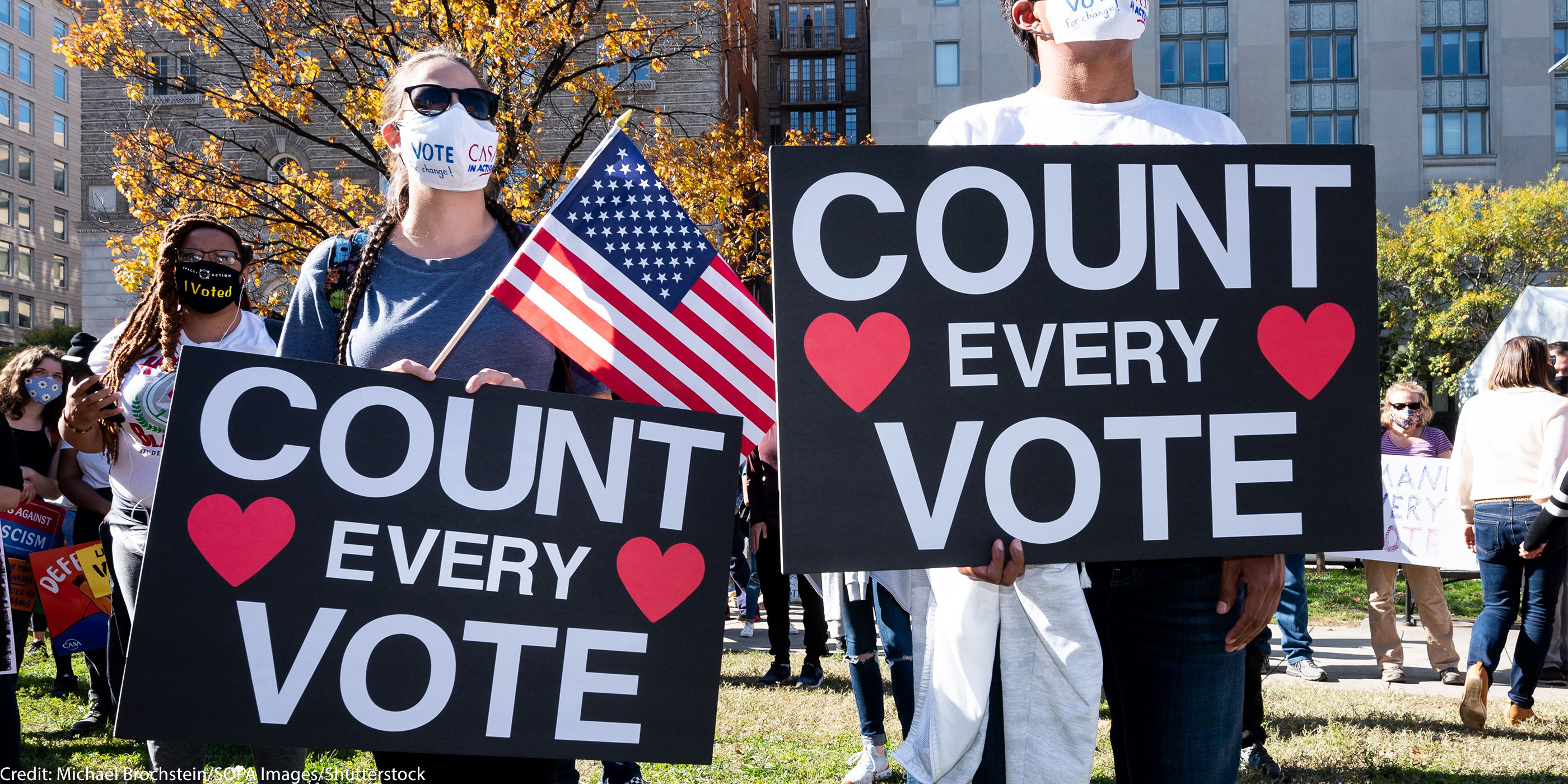
Two masked people hold signs that read "COUNT EVERY VOTE."

ONE: Mail-In and Absentee Ballots

2020’s infamous four-day wait for the presidential election to be called can, at least partially, be attributed to the large numbers of people who voted by mail during the pandemic. We know that processing mail-in ballots can be time consuming. Currently, some states allow election workers to begin this lengthy process before Election Day, while others still do not. In 2020, the majority of mail-in ballots came from Democratic-leaning voters. If this election follows this pattern, there may be a late-in-the-day surge of votes in certain states.

Some states, such as Nevada and California, allow mail-in ballots that are postmarked by Election Day and arrive a specified number of days after Election Day to still be counted. This means that unofficial election results in some states may come days after Election Day.

TWO: State-Based Procedures and Processing Times

Every state has its own rules and procedures for how to count the vote.

For example, not all states offer early voting, or only offer short periods of early voting, which can possibly lead to long lines and bottlenecks on Election Day that extend the time it takes to gather all the votes. Additionally, many states, such as Pennsylvania and Wisconsin, do not begin processing any ballots – including mail-in or absentee ballots – until Election Day. It is therefore possible, and in some cases likely, that results won’t be projected until after Election Day. In other states, like Georgia and Michigan, pre-processing of mail-in and absentee ballots is allowed before Election Day, so projected election results in those states may come sooner, including on Election Night or the following morning.

THREE: Verifying and Counting the Vote

Canvassing is the process of counting ballots, ensuring all ballots are accounted for, and that only valid ballots are counted.

Importantly, many states also have automatic recount procedures that trigger at certain points, such as if the race is within 0.5 percent, that can also extend the canvassing process. For swing states, like Pennsylvnia, or, more recently, Nevada, the margin of victory for either candidate may be small. In these scenarios, states may recount the vote, or presidential candidates may call for a recount, which means that the states that could determine the outcome of the election may not be called until November 6th or even later.

At the ACLU, we know that these checks and verifications are standard procedure to ensure that every vote is counted. We also know that select nationwide processes can help expand access and improve the right to vote, including same-day and online voter registration across states, required early-voting access in all states for a set period, and no-excuse vote-by-mail to allow voters across the country to request and cast an absentee/mail ballot with no excuse or reason necessary.

This election, we’ll be watching the results roll in and knowing that our work doesn’t stop when the polls close. Ensuring the future of democracy requires us to safeguard our right to vote today. Join us and demand that every vote be counted and every validated result be certified to protect our freedoms.


Published November 5, 2024 at 08:39PM
via ACLU https://ift.tt/MsdnxWy

ACLU: Why Counting the Vote Can, and Should, Take Time

Why Counting the Vote Can, and Should, Take Time

Everyone remembers the four days it took to officially call the 2020 presidential race for Joe Biden. While that election seemed to take an inordinate amount of time, it’s normal for it to take several days to process all of the ballots.

Vote counting takes time, especially when the race is as close as the 2024 election appears to be. This year’s election is projected to have fewer mail-in ballots, and thus may take less time to call than the 2020 race, but each state still has its own election administration procedures on how, and when, to process ballots. These are standard processes that, yes, can cause the election results to take more time. They also are part of the system of checks and verifications that keep our elections fair and free.

In every election, teams of people from both parties work together at every step of the voting, counting, and reporting process to ensure that results are verified before they are officially certified. At the ACLU, we’ve kept close watch on this process. Below, we outline three main things that impact when the election is called.

Two masked people hold signs that read "COUNT EVERY VOTE."

ONE: Mail-In and Absentee Ballots

2020’s infamous four-day wait for the presidential election to be called can, at least partially, be attributed to the large numbers of people who voted by mail during the pandemic. We know that processing mail-in ballots can be time consuming. Currently, some states allow election workers to begin this lengthy process before Election Day, while others still do not. In 2020, the majority of mail-in ballots came from Democratic-leaning voters. If this election follows this pattern, there may be a late-in-the-day surge of votes in certain states.

Some states, such as Nevada and California, allow mail-in ballots that are postmarked by Election Day and arrive a specified number of days after Election Day to still be counted. This means that unofficial election results in some states may come days after Election Day.

TWO: State-Based Procedures and Processing Times

Every state has its own rules and procedures for how to count the vote.

For example, not all states offer early voting, or only offer short periods of early voting, which can possibly lead to long lines and bottlenecks on Election Day that extend the time it takes to gather all the votes. Additionally, many states, such as Pennsylvania and Wisconsin, do not begin processing any ballots – including mail-in or absentee ballots – until Election Day. It is therefore possible, and in some cases likely, that results won’t be projected until after Election Day. In other states, like Georgia and Michigan, pre-processing of mail-in and absentee ballots is allowed before Election Day, so projected election results in those states may come sooner, including on Election Night or the following morning.

THREE: Verifying and Counting the Vote

Canvassing is the process of counting ballots, ensuring all ballots are accounted for, and that only valid ballots are counted.

Importantly, many states also have automatic recount procedures that trigger at certain points, such as if the race is within 0.5 percent, that can also extend the canvassing process. For swing states, like Pennsylvnia, or, more recently, Nevada, the margin of victory for either candidate may be small. In these scenarios, states may recount the vote, or presidential candidates may call for a recount, which means that the states that could determine the outcome of the election may not be called until November 6th or even later.

At the ACLU, we know that these checks and verifications are standard procedure to ensure that every vote is counted. We also know that select nationwide processes can help expand access and improve the right to vote, including same-day and online voter registration across states, required early-voting access in all states for a set period, and no-excuse vote-by-mail to allow voters across the country to request and cast an absentee/mail ballot with no excuse or reason necessary.

This election, we’ll be watching the results roll in and knowing that our work doesn’t stop when the polls close. Ensuring the future of democracy requires us to safeguard our right to vote today. Join us and demand that every vote be counted and every validated result be certified to protect our freedoms.


Published November 5, 2024 at 03:09PM
via ACLU https://ift.tt/xUcNokR

Monday, 4 November 2024

ACLU: This Election Day, States Lead the Fight for Reproductive Freedom

This Election Day, States Lead the Fight for Reproductive Freedom

Since the fall of Roe, Americans have consistently supported reproductive freedom at the polls. Knowing this, ACLU advocates across the country have worked to ensure the people have a say on reproductive freedom. On Election Day, voters will decide on ten ballot initiatives that will protect and increase abortion access at the state level.

While 13 states currently have total abortion bans in effect, Missouri was the first state to enforce its ban, taking action mere minutes after the fall of Roe. Alongside local partners, the ACLU of Missouri has spent years fighting to secure access to reproductive health care. Today, Missourians will decide on Amendment 3, which would enshrine the right to reproductive freedom in their state constitution.

In Arizona, lawmakers have likewise aggressively restricted abortion access for decades, imposing a 15-week ban on abortion after Roe was overturned and trying to reinstate an 1864 total abortion ban. The ACLU of Arizona was one of the leading organizations supporting Proposition 139, the Arizona Abortion Access Act, which would establish a fundamental right to abortion in the state’s constitution.

Ahead of Election Day, we spoke with Tori Schafer, the director for Policy and Campaigns at the ACLU of Missouri, about what Amendment 3 means for the future of reproductive health access in her state. We also spoke to Victoria López, the director of program and strategy at the ACLU of Arizona, about the impact of Proposition 139.

This conversation has been edited and condensed for clarity.

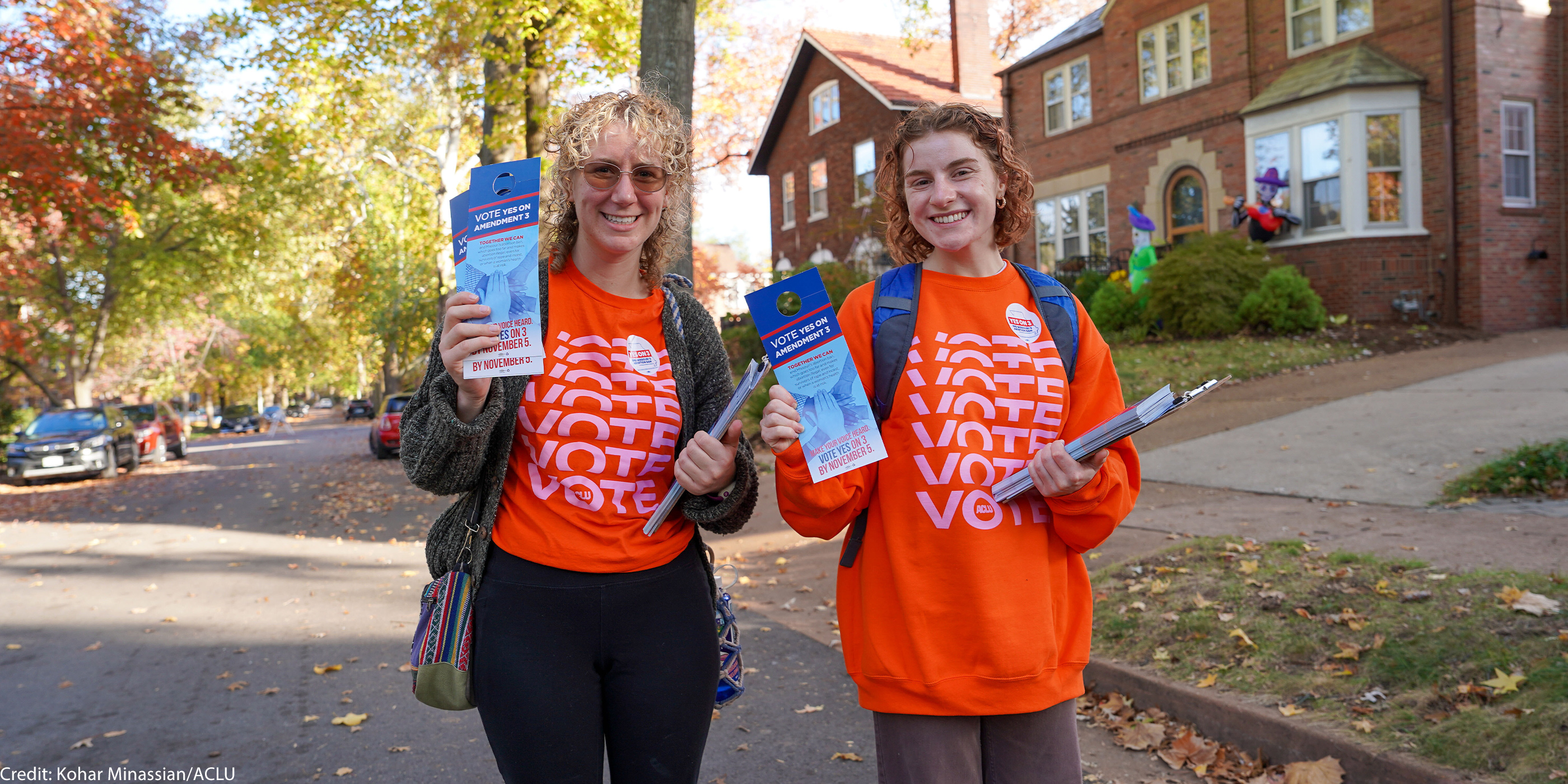
Voter volunteers holding voting pamphlets.

ACLU: Tell us about the history of reproductive rights in your state?

Schafer: In 2019, despite a majority of Missourians supporting reproductive rights, the state legislature passed one of the most restrictive abortion bans in the country. Immediately, the ACLU of Missouri began organizing with partners to reject the law’s enactment [at the ballot]. The secretary of state stalled these efforts and, after lengthy litigation, we prevailed, but without enough time to collect the required signatures to initiate the referendum process. Frustrated with constantly playing defense, we began exploring the idea of bringing full constitutional protections for reproductive freedom directly to the people.

Lopez: Arizona has a long history of passing restrictive laws that prevent people from getting the abortion care they need. The ACLU of Arizona has consistently been involved in litigation and advocacy to challenge abortion restrictions, including a fetal personhood law [and] 15 and 20-week bans.

When I started at the ACLU of Arizona, one of the first cases I learned about was a challenge to a policy requiring women in jail to pay for their own transportation to medical appointments for abortion care. That case was my first on-the-ground experience fighting to ensure abortion access for all people in our state.

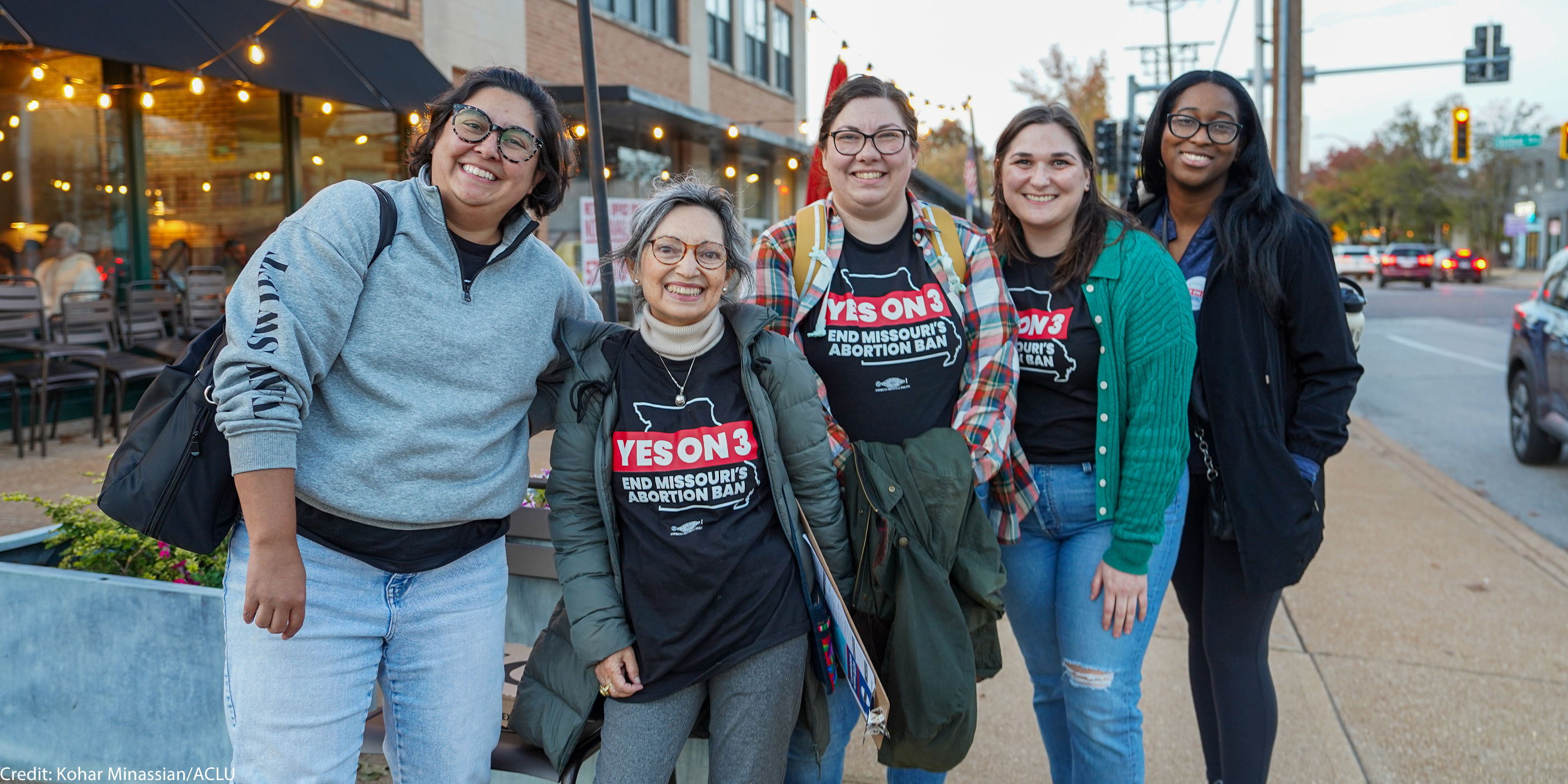
Four voting volunteers with three of them wearing t-shirts reading "YES ON 3"

ACLU: How would the ballot measures in your state help residents?

Schafer: This ballot measure, “The Right to Reproductive Freedom,” is a constitutional amendment that would end the state’s abortion ban and give Missourians the right to make their own health care decisions — free from political interference. It also protects other forms of reproductive healthcare, including prenatal care, miscarriage care, and respectful birthing conditions.

Lopez: Proposition 139, the Arizona Abortion Access Act, is a people-powered initiative that establishes a fundamental right to abortion in our state’s constitution.

Prop 139 is based on that very-Arizona idea that politicians should not interfere in private medical decisions. As a “battleground” state with an abortion initiative on our ballot, we also see the direct connection between defending democracy against extremist threats so our communities can achieve the rights and dignity they deserve, including abortion access.

ACLU: Getting measures on the ballot is often challenging. What has the fight for this ballot measure been like?

Schafer: After many conversations with reproductive health care experts, community leaders, and lawyers, the committee filed the ballot measure in March 2023. However, the secretary of state refused to certify the measure. It was the first time a secretary tried to undermine the process in this way. That’s when we went to the Missouri Supreme Court for the first time – and won. After two more lawsuits to block misleading ballot summary questions and exaggerated claims about the measure's fiscal impact, the committee began collecting signatures in January 2024 and gathered more than double the required amount.

An incredible amount of work from volunteers and organizers across the state, a total of five legal challenges, and boundless hope have led to voters having Amendment 3 on their ballot.

Lopez: Following the Dobbs decision, Arizonans faced a complicated and shifting landscape around their right to abortion. We quickly saw efforts to reinstate a Civil War-era abortion ban from a time before Arizona was even a state that would have banned abortion in almost every case.

We worked with partners to successfully advocate at the legislature and through litigation to ensure this ban would never take effect. While the Arizona Supreme Court ultimately decided to reinstate the 1864 ban on abortion, subsequent legislative advocacy resulted in the repeal of that law. Fortunately, we never saw that antiquated law go into effect. However, the legislature left a 15-week ban in effect that has denied countless Arizonans access to needed care. In response to these attacks on their rights, communities across the state took action, collecting over 820,000 signatures, more than any ballot measure in the state's history, to qualify for the ballot.

ACLU: How does your state fit into the nationwide fight for our rights?

Schafer: Missouri was the first state to enforce a total abortion ban after Dobbs. When we pass Amendment 3, we’ll be the first state to end a total abortion ban [in effect]. I hope people see victories in states like mine and think, “If you can win in Missouri, we can win everywhere!” In the end, this vote isn’t about pushing one’s beliefs on others. It’s about respecting the personal freedoms we deeply value here in Missouri — the freedom to make decisions for ourselves, our families, and our future. We know the vast majority of Americans agree with this principle.

Lopez: In this historic election, where Arizona is a deciding factor, my daughter is voting for the first time. I am so proud to have been a part of this campaign and that she has been able to witness the nationwide support for, and success of, this campaign since the very beginning. We know this fight in Arizona is only part of a nationwide movement to ensure every person, in every state, can access the care they need and deserve.

Paid for by American Civil Liberties Union, Inc. Anthony Romero, Executive Director, 125 Broad Street New York, NY 10004, and authorized by Missourians for Constitutional Freedom and in coordination with Arizona for Abortion Access.


Published November 5, 2024 at 02:28AM
via ACLU https://ift.tt/x7Fkqd3

ACLU: This Election Day, States Lead the Fight for Reproductive Freedom

This Election Day, States Lead the Fight for Reproductive Freedom

Since the fall of Roe, Americans have consistently supported reproductive freedom at the polls. Knowing this, ACLU advocates across the country have worked to ensure the people have a say on reproductive freedom. On Election Day, voters will decide on ten ballot initiatives that will protect and increase abortion access at the state level.

While 13 states currently have total abortion bans in effect, Missouri was the first state to enforce its ban, taking action mere minutes after the fall of Roe. Alongside local partners, the ACLU of Missouri has spent years fighting to secure access to reproductive health care. Today, Missourians will decide on Amendment 3, which would enshrine the right to reproductive freedom in their state constitution.

In Arizona, lawmakers have likewise aggressively restricted abortion access for decades, imposing a 15-week ban on abortion after Roe was overturned and trying to reinstate an 1864 total abortion ban. The ACLU of Arizona was one of the leading organizations supporting Proposition 139, the Arizona Abortion Access Act, which would establish a fundamental right to abortion in the state’s constitution.

Ahead of Election Day, we spoke with Tori Schafer, the director for Policy and Campaigns at the ACLU of Missouri, about what Amendment 3 means for the future of reproductive health access in her state. We also spoke to Victoria López, the director of program and strategy at the ACLU of Arizona, about the impact of Proposition 139.

This conversation has been edited and condensed for clarity.

Voter volunteers holding voting pamphlets.

ACLU: Tell us about the history of reproductive rights in your state?

Schafer: In 2019, despite a majority of Missourians supporting reproductive rights, the state legislature passed one of the most restrictive abortion bans in the country. Immediately, the ACLU of Missouri began organizing with partners to reject the law’s enactment [at the ballot]. The secretary of state stalled these efforts and, after lengthy litigation, we prevailed, but without enough time to collect the required signatures to initiate the referendum process. Frustrated with constantly playing defense, we began exploring the idea of bringing full constitutional protections for reproductive freedom directly to the people.

Lopez: Arizona has a long history of passing restrictive laws that prevent people from getting the abortion care they need. The ACLU of Arizona has consistently been involved in litigation and advocacy to challenge abortion restrictions, including a fetal personhood law [and] 15 and 20-week bans.

When I started at the ACLU of Arizona, one of the first cases I learned about was a challenge to a policy requiring women in jail to pay for their own transportation to medical appointments for abortion care. That case was my first on-the-ground experience fighting to ensure abortion access for all people in our state.

Four voting volunteers with three of them wearing t-shirts reading "YES ON 3"

ACLU: How would the ballot measures in your state help residents?

Schafer: This ballot measure, “The Right to Reproductive Freedom,” is a constitutional amendment that would end the state’s abortion ban and give Missourians the right to make their own health care decisions — free from political interference. It also protects other forms of reproductive healthcare, including prenatal care, miscarriage care, and respectful birthing conditions.

Lopez: Proposition 139, the Arizona Abortion Access Act, is a people-powered initiative that establishes a fundamental right to abortion in our state’s constitution.

Prop 139 is based on that very-Arizona idea that politicians should not interfere in private medical decisions. As a “battleground” state with an abortion initiative on our ballot, we also see the direct connection between defending democracy against extremist threats so our communities can achieve the rights and dignity they deserve, including abortion access.

ACLU: Getting measures on the ballot is often challenging. What has the fight for this ballot measure been like?

Schafer: After many conversations with reproductive health care experts, community leaders, and lawyers, the committee filed the ballot measure in March 2023. However, the secretary of state refused to certify the measure. It was the first time a secretary tried to undermine the process in this way. That’s when we went to the Missouri Supreme Court for the first time – and won. After two more lawsuits to block misleading ballot summary questions and exaggerated claims about the measure's fiscal impact, the committee began collecting signatures in January 2024 and gathered more than double the required amount.

An incredible amount of work from volunteers and organizers across the state, a total of five legal challenges, and boundless hope have led to voters having Amendment 3 on their ballot.

Lopez: Following the Dobbs decision, Arizonans faced a complicated and shifting landscape around their right to abortion. We quickly saw efforts to reinstate a Civil War-era abortion ban from a time before Arizona was even a state that would have banned abortion in almost every case.

We worked with partners to successfully advocate at the legislature and through litigation to ensure this ban would never take effect. While the Arizona Supreme Court ultimately decided to reinstate the 1864 ban on abortion, subsequent legislative advocacy resulted in the repeal of that law. Fortunately, we never saw that antiquated law go into effect. However, the legislature left a 15-week ban in effect that has denied countless Arizonans access to needed care. In response to these attacks on their rights, communities across the state took action, collecting over 820,000 signatures, more than any ballot measure in the state's history, to qualify for the ballot.

ACLU: How does your state fit into the nationwide fight for our rights?

Schafer: Missouri was the first state to enforce a total abortion ban after Dobbs. When we pass Amendment 3, we’ll be the first state to end a total abortion ban [in effect]. I hope people see victories in states like mine and think, “If you can win in Missouri, we can win everywhere!” In the end, this vote isn’t about pushing one’s beliefs on others. It’s about respecting the personal freedoms we deeply value here in Missouri — the freedom to make decisions for ourselves, our families, and our future. We know the vast majority of Americans agree with this principle.

Lopez: In this historic election, where Arizona is a deciding factor, my daughter is voting for the first time. I am so proud to have been a part of this campaign and that she has been able to witness the nationwide support for, and success of, this campaign since the very beginning. We know this fight in Arizona is only part of a nationwide movement to ensure every person, in every state, can access the care they need and deserve.

Paid for by American Civil Liberties Union, Inc. Anthony Romero, Executive Director, 125 Broad Street New York, NY 10004, and authorized by Missourians for Constitutional Freedom and in coordination with Arizona for Abortion Access.


Published November 4, 2024 at 08:58PM
via ACLU https://ift.tt/jVL82Cv