Friday, 24 May 2019

ACLU: Black Trans Women Are Being Murdered in the Streets. Now the Trump Administration Wants to Turn Us Away From Shelters and Health Care.

Black Trans Women Are Being Murdered in the Streets. Now the Trump Administration Wants to Turn Us Away From Shelters and Health Care.
Two new rules from the Trump Administration will leave transgender people vulnerable to violence, discrimination, and even death.

It has been a horrific week for transgender and non-binary people. Muhlaysia Booker, Claire Legato, and Michelle Simone are Black trans women who have been murdered in the past week. At least five Black trans women have been killed so far in 2019.

On Wednesday, the Department of Housing and Urban Development wants to give federally funded shelters a license to discriminate and turn away transgender people. The policy move is seen by many transgender and non-binary people as an act of violence on our community and our lives.

Then Friday, the Department of Health and Human Services announced its plan to take away protections for trans people from discrimination in healthcare. Like many Black trans women, I struggled to find employment and experienced homelessness. I supported myself, and my family, by doing sex work. I was once assaulted and robbed by a client. Even in New York City, outside of the Stonewall Inn, I have been attacked and hospitalized.

For many trans and non-binary people, particularly Black trans women, our homes are not safe. Our schools are not safe. Our workplaces are not safe. We are ridiculed by health care providers and denied basic and necessary health care. When we don’t feel safe to get lifesaving medical care, and when shelters that receive taxpayer dollars are allowed to turn me and my community away, there is no place to go but the streets, where we face violence and murder. And too often, just like I experienced, law enforcement fails to respond.
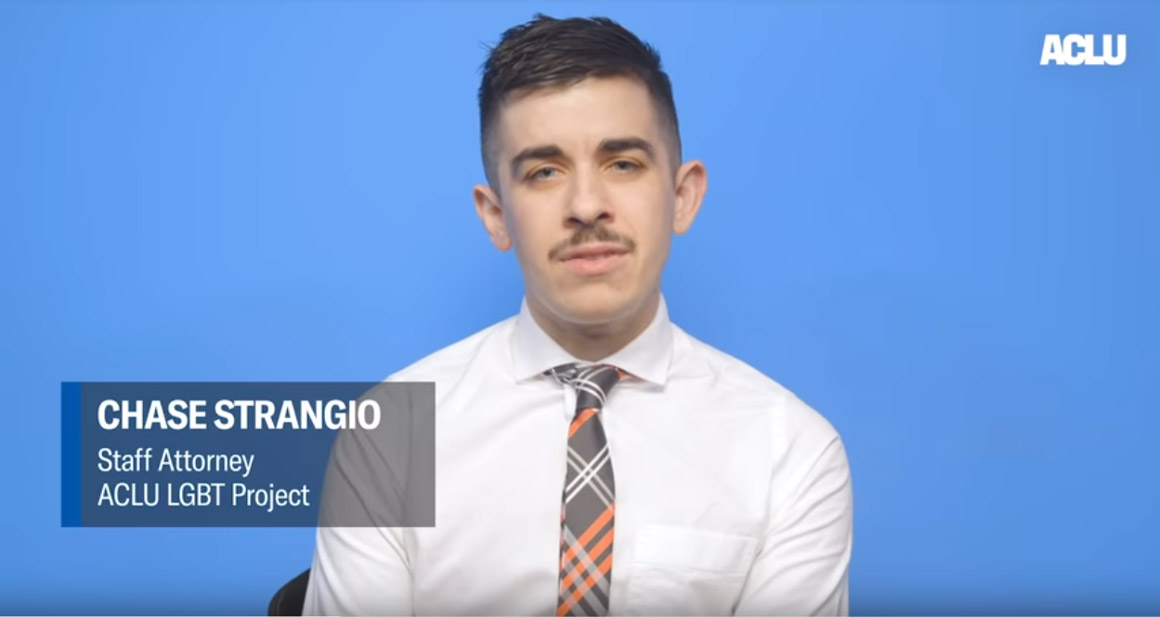
mytubethumbplay
%3Ciframe%20allow%3D%22accelerometer%3B%20autoplay%3B%20encrypted-media%3B%20gyroscope%3B%20picture-in-picture%22%20allowfullscreen%3D%22%22%20frameborder%3D%220%22%20height%3D%22315%22%20src%3D%22https%3A%2F%2Fwww.youtube.com%2Fembed%2Fy4sQVxCp5JE%3Fautoplay%3D1%26version%3D3%22%20thumb%3D%22https%3A%2F%2Fwww.aclu.org%2Fsites%2Fdefault%2Ffiles%2Fweb19-chasestrangio-1160x617.jpg%22%20width%3D%22560%22%3E%3C%2Fiframe%3E
Privacy statement. This embed will serve content from youtube.com.

Transgender people need our friends and family to see us, honor and acknowledge who we are, and say publicly that we belong.

In announcing the new proposal, which has not yet been formalized, HUD continues to spread lies and myths about transgender people that we have seen before. The Trump administration has been saying transgender people are lying about who we are in our schools, workplaces, and the military. It even suggested in the HHS comments that sharing space with trans people violates the rights of non-transgender people.

Trans women are women. Trans men are men. Non-binary genders are real. We face violence and discrimination in almost every aspect of life. We are not a threat. And we have a right to belong in this country and in shelters. We deserve access to health care.

To fight back against these attacks, here are three things you can do:

Check-in: Ask the transgender and non-binary people in your life how they are and what support they need.

Speak-up: Ask candidates for office and elected officials how they will respond to the violence against transgender people.

Support: Reach out to trans-led organizations and ask how you can be a part of the fight in your own community.

Transgender and non-binary people are a part of our country as voters, as taxpayers, as students, as parents, and as employees. We cannot be erased, no matter what this administration does.


Published May 25, 2019 at 12:00AM
via ACLU http://bit.ly/2X5gdpS

ACLU: When President Trump Rejects Congressional Subpoenas, He Rejects the Constitution and the Powers it Gave Congress

When President Trump Rejects Congressional Subpoenas, He Rejects the Constitution and the Powers it Gave Congress
What President Trump objects to so strenuously is nothing more than a system of accountability.

President Trump really, really doesn’t like the fact that congressional committees are investigating him. On Wednesday, he was so mad that he stormed out of a meeting with House Speaker Nancy Pelosi about critically needed infrastructure legislation after only three minutes, much like the proverbial boy who takes the football home if he loses a disputed call.

Trump’s tantrum reflects the fact that the American people and their representatives are getting closer to seeing behind the curtain of secrecy that Trump has wrapped around his financial dealings — even where they implicate serious conflicts of interest prohibited by the Constitution’s ban on presidents accepting “emoluments,” or anything of value, from foreign or domestic government officials.

On Monday and Wednesday, federal judges in D.C. and New York rejected Trump’s efforts to block subpoenas aimed at uncovering his financial records. Also on Wednesday, the New York Legislature cleared the way to disclosing Trump’s state tax returns.

What President Trump objects to so strenuously is nothing more than what the framers of our Constitution demanded: a system of accountability. The framers intentionally designed our government so that exactly this would happen. They called it checks and balances, believing that the best way to rein in abuses of power is to divide authority among the three branches of the federal government, as well as among the federal and state governments, so that the different branches will work to keep each other in line.

During Trump’s first two years in office, the framers’ plan was largely foiled by one-party rule. Republicans controlled both houses of Congress and the majority of the state legislatures, and a majority of the Supreme Court’s justices were Republican-appointees. And Republicans have shown little willingness to check this president. To date, Rep. Justin Amash is the only Republican member of Congress who has called out the president for the obstruction of justice so plainly detailed in the Mueller report. But in the midterms, the American people elected enough Democrats to flip control of the House of Representatives — and we are now seeing the separation of powers back in action. 

Trump is none too pleased. His first response was to stonewall on all subpoenas. He argued that House committees have no authority to investigate except where their investigation is tied to a specific piece of legislation. But that argument is dead wrong, and the federal courts have properly and resoundingly rejected it.

To do its job, Congress has to have broad investigative authority. It has to understand the scope of a problem before it can come up with a solution. Thus, when Facebook failed to protect the privacy of its users, Congress called in Mark Zuckerberg. When four Americans, including Ambassador J. Christopher Stevens, were killed in Benghazi, Congress held hearings to review what happened. In the 1970s, when it appeared that the CIA and FBI were spying on civil rights and anti-war organizations, a Senate committee conducted a massive investigation. And when James Comey was fired, Congress called him in to testify.

None of these hearings was tied to a specific bill; they were designed to understand a problem in order to determine whether a legislative response was called for. 

Thus, as U.S. District Judge Amit Mehta explained in his ruling Monday rejecting Trump’s effort to block a subpoena of his financial records, the courts have long ruled that Congress has very broad authority to conduct investigations. First, it can investigate any subject as to which it might legislate, whether it ever in fact passes or even introduces legislation. Accordingly, the Supreme Court has said, “the scope of the power of inquiry . . . is as penetrating and far-reaching as the potential power to enact and appropriate under the Constitution.”

And second, it has an “informing” function, which authorizes it to, in the Supreme Court’s words, “inquire into and publicize corruption, maladministration or inefficiency in agencies of the Government.” The Supreme Court has cited Woodrow Wilson for the proposition that “it is the proper duty of a representative body to look diligently into every affair of government and to talk much about what it sees. It is meant to be the eyes and the voice, and to embody the wisdom and will of its constituents.”

These authorities plainly cover investigations of Trump’s efforts to obstruct the Mueller investigation, potential conflicts of interest arising out of his past and present financial dealings, and his compliance — or lack thereof — with the tax code. So if the courts continue to do their job, Trump should be required to disclose much of what he has fought so long to keep from the public’s eyes — and that will then allow our representatives, and the people themselves, to decide on an appropriate response.

The ACLU, the nation’s oldest and largest constitutional rights organization, has always been committed to transparency, accountability, and checks and balances, precisely because we agree with the framers that these procedures safeguard liberty and constrain the abuse of government power. Since Trump has come into office, we’ve turned to the courts repeatedly to protect women’s reproductive rights, immigrants’ rights to due process, citizens’ voting rights, and everyone’s rights to privacy and liberty. The courts have played a critical part in maintaining the rule of law in the face of Trump’s excesses.

But we cannot rely exclusively on judges. Congress has an important checking function as well. And that can only operate if the president abides by basic norms of our Constitution — including that Congress has broad authority to investigate suspected abuse by the President himself.


Published May 24, 2019 at 06:00PM
via ACLU http://bit.ly/2EyBqS6

ACLU: When President Trump Rejects Congressional Subpoenas, He Rejects the Constitution and the Powers it Gave Congress

When President Trump Rejects Congressional Subpoenas, He Rejects the Constitution and the Powers it Gave Congress
What President Trump objects to so strenuously is nothing more than a system of accountability.

President Trump really, really doesn’t like the fact that congressional committees are investigating him. On Wednesday, he was so mad that he stormed out of a meeting with House Speaker Nancy Pelosi about critically needed infrastructure legislation after only three minutes, much like the proverbial boy who takes the football home if he loses a disputed call.

Trump’s tantrum reflects the fact that the American people and their representatives are getting closer to seeing behind the curtain of secrecy that Trump has wrapped around his financial dealings — even where they implicate serious conflicts of interest prohibited by the Constitution’s ban on presidents accepting “emoluments,” or anything of value, from foreign or domestic government officials.

On Monday and Wednesday, federal judges in D.C. and New York rejected Trump’s efforts to block subpoenas aimed at uncovering his financial records. Also on Wednesday, the New York Legislature cleared the way to disclosing Trump’s state tax returns.

What President Trump objects to so strenuously is nothing more than what the framers of our Constitution demanded: a system of accountability. The framers intentionally designed our government so that exactly this would happen. They called it checks and balances, believing that the best way to rein in abuses of power is to divide authority among the three branches of the federal government, as well as among the federal and state governments, so that the different branches will work to keep each other in line.

During Trump’s first two years in office, the framers’ plan was largely foiled by one-party rule. Republicans controlled both houses of Congress and the majority of the state legislatures, and a majority of the Supreme Court’s justices were Republican-appointees. And Republicans have shown little willingness to check this president. To date, Rep. Justin Amash is the only Republican member of Congress who has called out the president for the obstruction of justice so plainly detailed in the Mueller report. But in the midterms, the American people elected enough Democrats to flip control of the House of Representatives — and we are now seeing the separation of powers back in action. 

Trump is none too pleased. His first response was to stonewall on all subpoenas. He argued that House committees have no authority to investigate except where their investigation is tied to a specific piece of legislation. But that argument is dead wrong, and the federal courts have properly and resoundingly rejected it.

To do its job, Congress has to have broad investigative authority. It has to understand the scope of a problem before it can come up with a solution. Thus, when Facebook failed to protect the privacy of its users, Congress called in Mark Zuckerberg. When four Americans, including Ambassador J. Christopher Stevens, were killed in Benghazi, Congress held hearings to review what happened. In the 1970s, when it appeared that the CIA and FBI were spying on civil rights and anti-war organizations, a Senate committee conducted a massive investigation. And when James Comey was fired, Congress called him in to testify.

None of these hearings was tied to a specific bill; they were designed to understand a problem in order to determine whether a legislative response was called for. 

Thus, as U.S. District Judge Amit Mehta explained in his ruling Monday rejecting Trump’s effort to block a subpoena of his financial records, the courts have long ruled that Congress has very broad authority to conduct investigations. First, it can investigate any subject as to which it might legislate, whether it ever in fact passes or even introduces legislation. Accordingly, the Supreme Court has said, “the scope of the power of inquiry . . . is as penetrating and far-reaching as the potential power to enact and appropriate under the Constitution.”

And second, it has an “informing” function, which authorizes it to, in the Supreme Court’s words, “inquire into and publicize corruption, maladministration or inefficiency in agencies of the Government.” The Supreme Court has cited Woodrow Wilson for the proposition that “it is the proper duty of a representative body to look diligently into every affair of government and to talk much about what it sees. It is meant to be the eyes and the voice, and to embody the wisdom and will of its constituents.”

These authorities plainly cover investigations of Trump’s efforts to obstruct the Mueller investigation, potential conflicts of interest arising out of his past and present financial dealings, and his compliance — or lack thereof — with the tax code. So if the courts continue to do their job, Trump should be required to disclose much of what he has fought so long to keep from the public’s eyes — and that will then allow our representatives, and the people themselves, to decide on an appropriate response.

The ACLU, the nation’s oldest and largest constitutional rights organization, has always been committed to transparency, accountability, and checks and balances, precisely because we agree with the framers that these procedures safeguard liberty and constrain the abuse of government power. Since Trump has come into office, we’ve turned to the courts repeatedly to protect women’s reproductive rights, immigrants’ rights to due process, citizens’ voting rights, and everyone’s rights to privacy and liberty. The courts have played a critical part in maintaining the rule of law in the face of Trump’s excesses.

But we cannot rely exclusively on judges. Congress has an important checking function as well. And that can only operate if the president abides by basic norms of our Constitution — including that Congress has broad authority to investigate suspected abuse by the President himself.


Published May 24, 2019 at 10:30PM
via ACLU http://bit.ly/2EyBqS6

ACLU: Alabama Is Trying to Ban Abortion. Today We Filed Suit to Stop Them.

Alabama Is Trying to Ban Abortion. Today We Filed Suit to Stop Them.
Abortion is a right and this attack on abortion rights won’t succeed.

Last week, Alabama Governor Kay Ivey signed legislation banning nearly all abortions. The law, which threatens doctors with up to 99 years in prison for performing abortions, is the anti-abortion opposition’s true agenda on display: ban abortion, jail doctors, and push this essential health care out of reach.

These are undoubtedly dark times in the fight for reproductive freedom as Alabama and states across the South and Midwest aggressively push to place such onerous restrictions on abortion so that the procedure is all but rendered inaccessible. And this seemingly relentless attack on our freedom and dignity has had a disproportionate impact on the lives of Black people and other people of color, young people, and people with low-incomes. But make no mistake we have been and will continue to fight back: Abortion remains — and will remain — safe and legal in Alabama and in all 50 states.

Today, the ACLU, the ACLU of Alabama, and the Planned Parenthood Federation of Alabama filed a lawsuit on behalf of abortion providers in the state that will challenge this extremist law. Indeed, as even the sponsors and supporters of the law — even Governor Ivey herself — admit, the ban is blatantly unconstitutional. For more than 45 years, the Supreme Court has repeatedly — and unequivocally — held that the freedom to decide whether and when to have a child is one of the most intimate and personal decisions a person can make in their lifetime, and is central to the liberty protected by the Fourteenth Amendment.

While Alabama’s abortion ban may be its most extreme attack on this fundamental right, it certainly isn’t the first. For nearly a decade, the Alabama legislature has been pushing medically unnecessary and politically-motivated laws — a ban on the safest and most common second-trimester abortion procedure, and absurd licensing requirements that could have forced multiple clinics in the state to close. But the ACLU has never lost a legal challenge to an abortion restriction in Alabama yet, and this one will fare no better.

When all is said and done, Alabama will have wasted millions of dollars of taxpayer money in a fight it won’t win. But people need to keep making sure their voices are heard. Emboldened by President Trump’s anti-abortion agenda, state lawmakers are trying to pass laws intended to politicize the Supreme Court and strip Americans of their constitutional rights.

For decades, in Alabama and across the country, we’ve been fighting in the courts and the streets to protect people’s right to abortion. Just this last week we mobilized tens of thousands of our members to join our partner organizations at nearly 500 events across the country. Alabama isn’t alone in its efforts to roll back the clock to an era where abortion was illegal. Earlier this year, Kentucky, Georgia, Ohio, and Mississippi also enacted abortion bans. We’ve filed suit against the Ohio and Kentucky bans, and we’re in the process of putting together a legal challenge to Georgia’s as you read this.

Lawmakers in these states want you to forget the truth: Abortion is constitutionally protected, and you have the right to access one without having to apologize or explain yourself to any government official — anywhere. These bans are unconstitutional, and none of them have gone into effect, including Alabama’s, and we aim to keep it that way.

The ACLU stands with our partners and allies in Alabama — and across the country — in telling lawmakers that they will not impose their extremist views on us, and their attack on abortion rights won’t succeed.


Published May 24, 2019 at 04:30PM
via ACLU http://bit.ly/2HzcprM

ACLU: Alabama Is Trying to Ban Abortion. Today We Filed Suit to Stop Them.

Alabama Is Trying to Ban Abortion. Today We Filed Suit to Stop Them.
Abortion is a right and this attack on abortion rights won’t succeed.

Last week, Alabama Governor Kay Ivey signed legislation banning nearly all abortions. The law, which threatens doctors with up to 99 years in prison for performing abortions, is the anti-abortion opposition’s true agenda on display: ban abortion, jail doctors, and push this essential health care out of reach.

These are undoubtedly dark times in the fight for reproductive freedom as Alabama and states across the South and Midwest aggressively push to place such onerous restrictions on abortion so that the procedure is all but rendered inaccessible. And this seemingly relentless attack on our freedom and dignity has had a disproportionate impact on the lives of Black people and other people of color, young people, and people with low-incomes. But make no mistake we have been and will continue to fight back: Abortion remains — and will remain — safe and legal in Alabama and in all 50 states.

Today, the ACLU, the ACLU of Alabama, and the Planned Parenthood Federation of Alabama filed a lawsuit on behalf of abortion providers in the state that will challenge this extremist law. Indeed, as even the sponsors and supporters of the law — even Governor Ivey herself — admit, the ban is blatantly unconstitutional. For more than 45 years, the Supreme Court has repeatedly — and unequivocally — held that the freedom to decide whether and when to have a child is one of the most intimate and personal decisions a person can make in their lifetime, and is central to the liberty protected by the Fourteenth Amendment.

While Alabama’s abortion ban may be its most extreme attack on this fundamental right, it certainly isn’t the first. For nearly a decade, the Alabama legislature has been pushing medically unnecessary and politically-motivated laws — a ban on the safest and most common second-trimester abortion procedure, and absurd licensing requirements that could have forced multiple clinics in the state to close. But the ACLU has never lost a legal challenge to an abortion restriction in Alabama yet, and this one will fare no better.

When all is said and done, Alabama will have wasted millions of dollars of taxpayer money in a fight it won’t win. But people need to keep making sure their voices are heard. Emboldened by President Trump’s anti-abortion agenda, state lawmakers are trying to pass laws intended to politicize the Supreme Court and strip Americans of their constitutional rights.

For decades, in Alabama and across the country, we’ve been fighting in the courts and the streets to protect people’s right to abortion. Just this last week we mobilized tens of thousands of our members to join our partner organizations at nearly 500 events across the country. Alabama isn’t alone in its efforts to roll back the clock to an era where abortion was illegal. Earlier this year, Kentucky, Georgia, Ohio, and Mississippi also enacted abortion bans. We’ve filed suit against the Ohio and Kentucky bans, and we’re in the process of putting together a legal challenge to Georgia’s as you read this.

Lawmakers in these states want you to forget the truth: Abortion is constitutionally protected, and you have the right to access one without having to apologize or explain yourself to any government official — anywhere. These bans are unconstitutional, and none of them have gone into effect, including Alabama’s, and we aim to keep it that way.

The ACLU stands with our partners and allies in Alabama — and across the country — in telling lawmakers that they will not impose their extremist views on us, and their attack on abortion rights won’t succeed.


Published May 24, 2019 at 09:00PM
via ACLU http://bit.ly/2HzcprM

El Salvador : 2019 Article IV Consultation-Press Release; Staff Report; and Statement by the Executive Director for El Salvador

El Salvador : 2019 Article IV Consultation-Press Release; Staff Report; and Statement by the Executive Director for El Salvador
Published May 24, 2019 at 04:00PM
Read more at imf.org

Thursday, 23 May 2019

ACLU: The Next President Can Cut Incarceration Rates in Half

The Next President Can Cut Incarceration Rates in Half
We're starting to make progress on reducing the incarcerated population, but we need national leadership to get us to our goal.

On any given night in the United States, more than 2.2 million people go to sleep behind bars in prisons and jails. People cycle in and out of jail more than 10 million times a year. The U.S. incarcerates more people, both in absolute numbers and per capita, than any other nation in the world.

This current state of affairs is the result of policy decisions made over the last several decades to lock up more people with longer sentences and to make it much easier to go back to prison once out. These “tough on crime” policies have disproportionately targeted Black and brown people, shattered neighborhoods, and separated families.

Bold leadership from the next president can help bring an end to this shameful era.

As part of our Rights for All campaign, we are asking candidates for president to pledge to cut the federal prison system by 50% by the end of their presidency and to work with states to cut their jail and prison populations by 50%.

The next president must tackle the country’s mass incarceration crisis in a way that restores fundamental civil liberties, upholds human dignity, combats racial injustice, prioritizes rehabilitation, and leads to safer and healthier communities.

Members of both parties have supported efforts to cut the jail and prison population, including efforts to reduce harsh prison sentences and pre-trial incarceration, invest in community-based social services, and use mental health treatment and substance abuse counseling as alternatives to incarceration.

Indeed, the recent signing of the federal First Step Act shows that efforts to reduce the number of people behind bars have bipartisan support. This federal legislation followed years of bipartisan activity in the states, where Republicans and Democrats have been working together to end mandatory minimums and scale back long prison sentences, end the war on drugs, grant parole to people who are ready to go back home, expand mental health services, hold prosecutors accountable for fueling mass incarceration, and much more. In 2018 alone, at least 122 criminal justice reform bills passed in the states. The result will be thousands of fewer people incarcerated.

We’re starting to see the returns on past efforts lead to significant reductions in incarceration. Bail reform, which is meant to reduce the number of people who are jailed before trial, took effect in New Jersey in 2017. And since then, the jail population has decreased by more than 20% while crime rates continue to go down.

There are a number of possible policy paths that could lead to a 50% reduction in the incarcerated population, but the biggest piece we lack is the leadership to get there. What we need is a president who can show it is possible by cutting the federal prison population 50% by the end of their presidency, while championing and incentivizing a 50% cut in the states.


Published May 23, 2019 at 10:00PM
via ACLU http://bit.ly/2JWrhSA