Friday, 27 September 2024

ACLU: W. Kamau Bell and Michigan's Top Rap Stars Get Down for Voting Rights

W. Kamau Bell and Michigan's Top Rap Stars Get Down for Voting Rights

Greeted by the newly constructed “Detroit” sign, my colleagues and I arrived in the Motor City for the final stop on the ACLU’s Know Your Rights bus tour. We didn’t actually ride our Know Your Rights bus to Detroit. Instead, we arrived to find the bus in all its glory parked outside the Garden Theater, just off the bustling Woodward Avenue. While Detroit is the last stop on our tour, the KYR bus has crisscrossed the country helping voters know their rights and feel empowered and excited to show up to the polls this November.

In Detroit, the ACLU KYR tour was hosting a live taping of our podcast, At Liberty, as well as a rap concert with the famed Danny Brown. As we entered the theater, well over an hour before the event started, the energy was already palpable. The venue was buzzing. Lights were flashing and enthusiastic volunteers prepped tables with free ACLU Know Your Rights swag, which included cans of La Colombe cold brew and Tony’s chocolates. As it approached time for the doors to open, people began to gather, many talking about the evening’s headliner, the rapper Danny Brown. One fan mentioned that this would be his 15th time seeing the Detroit legend perform.

Danny was closing our event. To kick us off was the comedian W. Kamau Bell hosting a live-taping of our At Liberty podcast. Loren Khogali, the executive director at the ACLU of Michigan, and Razi Jafri, a Detroit-based documentary filmmaker and producer joined Kamau in conversation on stage. Kamau’s lively energy quickly won over the crowd as he made lighthearted conversation about Detroit’s best food spots before diving into deeper topics, like Michigan’s long history of political organizing and the importance of voting.

Razi shared his insight on the mobilization of Muslim and Arab communities in southeast Michigan, emphasizing that such activism mirrored a growing power and movement across America, especially on college campuses. Loren and Kamau expanded the discussion, highlighting the intersectional history of Michigan’s activism. In particular, civil liberties and civil rights in Michigan improved when powerful coalitions of Black, Arab, and other diverse communities across the state worked together.

Kamau, Razi and Loren urged audiences to vote this election season, stressing the importance of understanding how voting intersects with all levels of government — from the president to the state Supreme Court. Loren’s parting words left a lasting impression: "Be curious and be critical. Get out and make a plan to vote!"
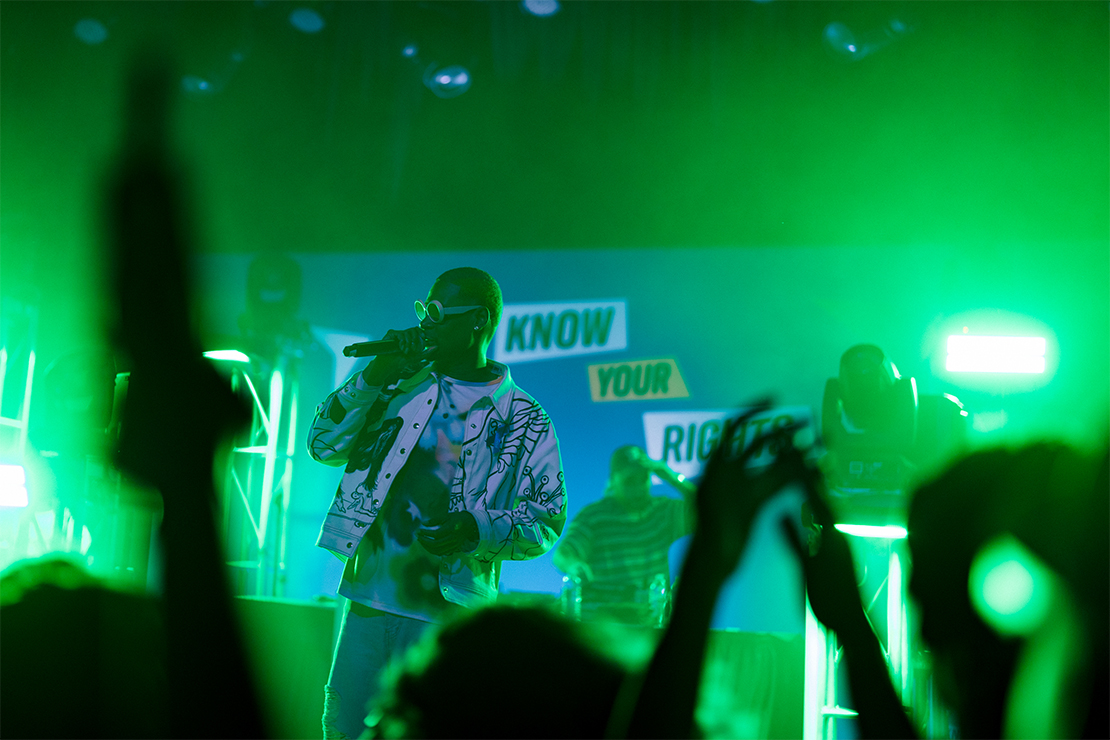
Danny Brown electrifies the stage at the Know Your Rights bus tour concert.

ACLU

The energy in the room continued to build as beatboxer Stevie Soul took the stage, warming up the crowd with his rhythmic skills. Soon, he was joined by Comic Rapper, improvising rhymes and getting the audience involved, fueling the anticipation for what was to come.Finally, the headline moment arrived. Detroit’s own Danny Brown hit the stage. The crowd erupted.

The Garden Theater pulsed with energy as the bass boomed and lights flashed. Fans crowded toward the stage, singing along word for word to hits like “Grown Up” and “Really Doe.” With his unique voice and flow, the performance was electric, and the connection between Danny and the Detroit community was undeniable.

As the night wound down and we stepped back out into the cool evening air, one fan’s voice carried over the crowd: “Know your rights!” It echoed down the street. It was a reminder that tonight was about more than just a show; it was about empowerment and democracy.

If you weren’t able to catch us on tour, you can still pledge to vote.


Published September 28, 2024 at 12:33AM
via ACLU https://ift.tt/hF6q0HV

ACLU: W. Kamau Bell and Michigan's Top Rap Stars Get Down for Voting Rights

W. Kamau Bell and Michigan's Top Rap Stars Get Down for Voting Rights

Greeted by the newly constructed “Detroit” sign, my colleagues and I arrived in the Motor City for the final stop on the ACLU’s Know Your Rights bus tour. We didn’t actually ride our Know Your Rights bus to Detroit. Instead, we arrived to find the bus in all its glory parked outside the Garden Theater, just off the bustling Woodward Avenue. While Detroit is the last stop on our tour, the KYR bus has crisscrossed the country helping voters know their rights and feel empowered and excited to show up to the polls this November.

In Detroit, the ACLU KYR tour was hosting a live taping of our podcast, At Liberty, as well as a rap concert with the famed Danny Brown. As we entered the theater, well over an hour before the event started, the energy was already palpable. The venue was buzzing. Lights were flashing and enthusiastic volunteers prepped tables with free ACLU Know Your Rights swag, which included cans of La Colombe cold brew and Tony’s chocolates. As it approached time for the doors to open, people began to gather, many talking about the evening’s headliner, the rapper Danny Brown. One fan mentioned that this would be his 15th time seeing the Detroit legend perform.

Danny was closing our event. To kick us off was the comedian W. Kamau Bell hosting a live-taping of our At Liberty podcast. Loren Khogali, the executive director at the ACLU of Michigan, and Razi Jafri, a Detroit-based documentary filmmaker and producer joined Kamau in conversation on stage. Kamau’s lively energy quickly won over the crowd as he made lighthearted conversation about Detroit’s best food spots before diving into deeper topics, like Michigan’s long history of political organizing and the importance of voting.

Razi shared his insight on the mobilization of Muslim and Arab communities in southeast Michigan, emphasizing that such activism mirrored a growing power and movement across America, especially on college campuses. Loren and Kamau expanded the discussion, highlighting the intersectional history of Michigan’s activism. In particular, civil liberties and civil rights in Michigan improved when powerful coalitions of Black, Arab, and other diverse communities across the state worked together.

Kamau, Razi and Loren urged audiences to vote this election season, stressing the importance of understanding how voting intersects with all levels of government — from the president to the state Supreme Court. Loren’s parting words left a lasting impression: "Be curious and be critical. Get out and make a plan to vote!"

Danny Brown electrifies the stage at the Know Your Rights bus tour concert.

ACLU

The energy in the room continued to build as beatboxer Stevie Soul took the stage, warming up the crowd with his rhythmic skills. Soon, he was joined by Comic Rapper, improvising rhymes and getting the audience involved, fueling the anticipation for what was to come.Finally, the headline moment arrived. Detroit’s own Danny Brown hit the stage. The crowd erupted.

The Garden Theater pulsed with energy as the bass boomed and lights flashed. Fans crowded toward the stage, singing along word for word to hits like “Grown Up” and “Really Doe.” With his unique voice and flow, the performance was electric, and the connection between Danny and the Detroit community was undeniable.

As the night wound down and we stepped back out into the cool evening air, one fan’s voice carried over the crowd: “Know your rights!” It echoed down the street. It was a reminder that tonight was about more than just a show; it was about empowerment and democracy.

If you weren’t able to catch us on tour, you can still pledge to vote.


Published September 27, 2024 at 08:03PM
via ACLU https://ift.tt/uD0MFXP

Friday, 20 September 2024

ACLU: How Border Policing Harms Undocumented People Seeking Abortion Care

How Border Policing Harms Undocumented People Seeking Abortion Care

For many of Texas’ 3 million border residents, going through federal interior checkpoints – where Border Patrol agents are permitted to screen vehicles for suspected noncitizens and can ask passengers about their citizenship and travel plans – can be an intimidating but predictable part of daily life. But for undocumented or mixed-status families, these checkpoints are literal barriers to their ability to access basic services and to leave the state for essential medical care like abortion. A new report from the ACLU details how these federal checkpoints – and the additional layer of anti-immigrant state policing – create a web of unnecessary, stressful, and dangerous barriers for people living in border communities isolated from abortion care.

The U.S. Border Patrol, an agency within Customs and Border Protection (CBP), operates more than 110 checkpoints and roving patrols within 100 miles of the international border. In Texas alone, there are around 19 interior checkpoints, stationed on the major – and sometimes only – roads in Texas within 100 miles of the U.S.-Mexico border. For undocumented individuals and their relatives trying to make decisions about their reproductive health, checkpoints staffed by armed guards and surveillance equipment are a significant obstacle to accessing medical care denied to them by the state's abortion ban.

In September 2021, Texas’ SB 8 went into effect, drastically limiting access to abortion and allowing private citizens to enforce a ban on abortion as early as six weeks in pregnancy. A year later, in 2022, the Supreme Court’s decision in Dobbs v. Jackson Women’s Health Organization overturned Roe v. Wade, activating Texas’ trigger law, which imposed a total abortion ban, and in turn, forced thousands of Texans to leave their state to get this essential care.

In 2023, Texas -- the largest state to ban abortion -- had the most residents traveling out of state for an abortion, mostly to New Mexico the only neighboring state where abortion remains legal for abortion care. Not only are more Texans traveling, but also in many cases, Texans are traveling further than anyone else in the country.

Someone from Brownsville, Texas, which is near the southernmost part of the state, would have to drive at least 12 hours one way, or 870 miles, to the closest abortion clinic in New Mexico. Someone from Laredo would face at least a 10-hour drive.

https://infogram.com/1pz2ej66kvd71vh2kewxn307dns11epn52g?live

But residents of south Texas are not only driving farther than anyone in the country for an abortion; in most cases, they must also drive through one or multiple interior federal checkpoints, risking arrest and deportation if they are undocumented.

A resident of Laredo driving to New Mexico, for example, will have to pass through six interior checkpoints in Texas alone, and then more in New Mexico. They can only reduce the number of inspections, but not avoid them all together, by adding several hours to their drive.

https://infogram.com/1p1rdvqzkjjdwesmd6n0g9nnmzbjw9nq21?live

Along with federal immigration checkpoints and roving patrols, these Texans and their families also must contend with Texas state police, including troopers with Governor Greg Abbott’s $11.2 billion-dollar anti-immigrant initiative, Operation Lone Star. Almost all counties along the southern Texas border participate in this program, which allows officers to arrest, prosecute, and punish undocumented immigrants under charges like trespassing. A person trying to leave Texas for abortion care may fear being stopped and questioned by state police or immigration agents about their reasons for travel given the hostile and racially discriminatory policing under Operation Lone Star and the close collaboration between border patrol and state police.

All levels of government must address legal and other barriers to abortion so that no one is prevented from accessing critical care under threat of deportation. As detailed in our report, action is needed to:

  • Ensure that people can safely reach abortion clinics without CBP checkpoints or other immigration enforcement impeding their travel or exposing people to potential detention and deportation;
  • Use prosecutorial discretion to protect a noncitizen from deportation who is arrested at a checkpoint when traveling to access critical medical care. The Department of Homeland Security (DHS) must also clarify that it will not consider these arrests or convictions, or the disclosure of having obtained abortion care, as a bar to any form of immigration relief;
  • Limit the collection, retention, and use of information obtained by CBP at checkpoints and through its broader surveillance technology;
  • Enact federal legislation to ensure that everyone can access abortion care if they need it, no matter who they are, where they live, or how much money they have; and,
  • In states where abortion is legal, remove barriers to access based on immigration status.

The ACLU will continue to work to ensure that everyone can access abortion care, no matter who they are, where they live, or how much money they have. And we will continue to fight against abusive border policing and surveillance that interferes with border residents’ ability to travel and get the services they need.


Published September 21, 2024 at 12:29AM
via ACLU https://ift.tt/OBjGT35

ACLU: How Border Policing Harms Undocumented People Seeking Abortion Care

How Border Policing Harms Undocumented People Seeking Abortion Care

For many of Texas’ 3 million border residents, going through federal interior checkpoints – where Border Patrol agents are permitted to screen vehicles for suspected noncitizens and can ask passengers about their citizenship and travel plans – can be an intimidating but predictable part of daily life. But for undocumented or mixed-status families, these checkpoints are literal barriers to their ability to access basic services and to leave the state for essential medical care like abortion. A new report from the ACLU details how these federal checkpoints – and the additional layer of anti-immigrant state policing – create a web of unnecessary, stressful, and dangerous barriers for people living in border communities isolated from abortion care.

The U.S. Border Patrol, an agency within Customs and Border Protection (CBP), operates more than 110 checkpoints and roving patrols within 100 miles of the international border. In Texas alone, there are around 19 interior checkpoints, stationed on the major – and sometimes only – roads in Texas within 100 miles of the U.S.-Mexico border. For undocumented individuals and their relatives trying to make decisions about their reproductive health, checkpoints staffed by armed guards and surveillance equipment are a significant obstacle to accessing medical care denied to them by the state's abortion ban.

In September 2021, Texas’ SB 8 went into effect, drastically limiting access to abortion and allowing private citizens to enforce a ban on abortion as early as six weeks in pregnancy. A year later, in 2022, the Supreme Court’s decision in Dobbs v. Jackson Women’s Health Organization overturned Roe v. Wade, activating Texas’ trigger law, which imposed a total abortion ban, and in turn, forced thousands of Texans to leave their state to get this essential care.

In 2023, Texas -- the largest state to ban abortion -- had the most residents traveling out of state for an abortion, mostly to New Mexico the only neighboring state where abortion remains legal for abortion care. Not only are more Texans traveling, but also in many cases, Texans are traveling further than anyone else in the country.

Someone from Brownsville, Texas, which is near the southernmost part of the state, would have to drive at least 12 hours one way, or 870 miles, to the closest abortion clinic in New Mexico. Someone from Laredo would face at least a 10-hour drive.

https://infogram.com/1pz2ej66kvd71vh2kewxn307dns11epn52g?live

But residents of south Texas are not only driving farther than anyone in the country for an abortion; in most cases, they must also drive through one or multiple interior federal checkpoints, risking arrest and deportation if they are undocumented.

A resident of Laredo driving to New Mexico, for example, will have to pass through six interior checkpoints in Texas alone, and then more in New Mexico. They can only reduce the number of inspections, but not avoid them all together, by adding several hours to their drive.

https://infogram.com/1p1rdvqzkjjdwesmd6n0g9nnmzbjw9nq21?live

Along with federal immigration checkpoints and roving patrols, these Texans and their families also must contend with Texas state police, including troopers with Governor Greg Abbott’s $11.2 billion-dollar anti-immigrant initiative, Operation Lone Star. Almost all counties along the southern Texas border participate in this program, which allows officers to arrest, prosecute, and punish undocumented immigrants under charges like trespassing. A person trying to leave Texas for abortion care may fear being stopped and questioned by state police or immigration agents about their reasons for travel given the hostile and racially discriminatory policing under Operation Lone Star and the close collaboration between border patrol and state police.

All levels of government must address legal and other barriers to abortion so that no one is prevented from accessing critical care under threat of deportation. As detailed in our report, action is needed to:

  • Ensure that people can safely reach abortion clinics without CBP checkpoints or other immigration enforcement impeding their travel or exposing people to potential detention and deportation;
  • Use prosecutorial discretion to protect a noncitizen from deportation who is arrested at a checkpoint when traveling to access critical medical care. The Department of Homeland Security (DHS) must also clarify that it will not consider these arrests or convictions, or the disclosure of having obtained abortion care, as a bar to any form of immigration relief;
  • Limit the collection, retention, and use of information obtained by CBP at checkpoints and through its broader surveillance technology;
  • Enact federal legislation to ensure that everyone can access abortion care if they need it, no matter who they are, where they live, or how much money they have; and,
  • In states where abortion is legal, remove barriers to access based on immigration status.

The ACLU will continue to work to ensure that everyone can access abortion care, no matter who they are, where they live, or how much money they have. And we will continue to fight against abusive border policing and surveillance that interferes with border residents’ ability to travel and get the services they need.


Published September 20, 2024 at 07:59PM
via ACLU https://ift.tt/64zuIdB

Tuesday, 17 September 2024

ACLU: ACLU Bus Tour Brings Banned Books to Georgia

ACLU Bus Tour Brings Banned Books to Georgia

When the ACLU team and I got to E. Shaver Booksellers Starland in Savannah, Georgia, we immediately were greeted with sunshine and humongous, centuries-old Southern oak trees. If that wasn’t beautiful enough, the bookshop itself had a water fountain in front, connected to a popular Savannah venue called “The Gingerbread House.”

The ACLU was in Georgia for the first stop of its premiere Know Your Rights Bus Tour where we hit the road – literally – with artists, influencers, advocates and community members to make sure voters know their rights and have a plan to vote. The tour has six stops and, at each stop, we’re highlighting several civil liberties issues that impact our most vulnerable communities.

In Georgia, we set up at this lovely bookshop to highlight the dangers of unconstitutional censorship. When we arrived at the bookstore, the ACLU team and I got right to work – bringing in boxes and boxes of voter information, ACLU swag, and banned books from “Twilight” to “The ABCs of Black History,” to give away to the Savannah community. While we unloaded, you could hear content creator Jameelah Jones and Seema Yasmin, author of the banned book ABCs of Queer History, discussing why it’s essential that people vote this year for our rights.


The ACLU launched its first-ever Know Your Rights Bus Tour so we could host the sort of dialogue that Jameelah and Seema were having amongst themselves with communities across the country. At 4:00 pm, we got to do just that. As Savannah community members piled in, they filled out a pledge to vote, picked up an infoguide on a voter activation event from the ACLU of Georgia, and waited to hear Seema read from her books the “ABCs of Queer History” and “Unbecoming.”

After the reading, Seema shared how her books, which featured LGBTQ+ and BlPOC characters, were being “soft banned” from libraries, classrooms, and stores. In her discussion with Jameelah and Sarah Hunt-Blackwell, the First Amendment policy advocate at the ACLU of Georgia, Seema highlighted how teachers would tell her that they were too scared to have her book in the classroom because they feared being punished by local school officials who are leading efforts to ban diverse materials from classrooms and libraries nationwide. Savannah residents were puzzled. Some even came up to me after the event to tell me they were shocked to find out that children's books were being censored.

It’s never easy to hear this going on in our local neighborhoods. At our next banned book event at Avid Bookshop in Athens, Georgia, Sarah, from the ACLU of GA, told attendees that banning books and limiting literacy education has historically been used to marginalize Black communities, saying, “the power of information and the power of education and knowledge is so grand that restricting it from certain populations was the only way to keep those populations discriminated against.” Sarah also highlighted why it’s important to protect our right to learn.

Armed with this information, community members felt empowered to take action. Seema asked the audience to use their power to affect change. "We rely on events like these, and people like yourselves, to spread information about the books and to organize so we [the LGBTQ+ community] can have a better future,” she said.

Later, attendees shared how the bus tour had inspired them to get involved. A member of the Booked Ban Club at the University of Georgia shared with me how they would use the information they learned to mobilize their supporters. In Savannah, a Black activist told me how he was part of the Crusade for Voters, and spent nights in jail and days at protests in the fight for Black Americans to have the right to vote, and how he is also calling for the next generation to use their right to vote. It was heartwarming to see the ACLU’s Know Your Rights Bus Tour continue a legacy of activism in Georgia and connect with community members in the state.

Our bus is now on the road to Philadelphia and Detroit for concerts, game shows and more to educate folks on civil liberties and the importance of voting. If you’re not able to catch us on tour, you can pledge to vote and learn more about how you can vote for your rights this year.


Published September 18, 2024 at 01:41AM
via ACLU https://ift.tt/KPZM7uE

ACLU: ACLU Bus Tour Brings Banned Books to Georgia

ACLU Bus Tour Brings Banned Books to Georgia

When the ACLU team and I got to E. Shaver Booksellers Starland in Savannah, Georgia, we immediately were greeted with sunshine and humongous, centuries-old Southern oak trees. If that wasn’t beautiful enough, the bookshop itself had a water fountain in front, connected to a popular Savannah venue called “The Gingerbread House.”

The ACLU was in Georgia for the first stop of its premiere Know Your Rights Bus Tour where we hit the road – literally – with artists, influencers, advocates and community members to make sure voters know their rights and have a plan to vote. The tour has six stops and, at each stop, we’re highlighting several civil liberties issues that impact our most vulnerable communities.

In Georgia, we set up at this lovely bookshop to highlight the dangers of unconstitutional censorship. When we arrived at the bookstore, the ACLU team and I got right to work – bringing in boxes and boxes of voter information, ACLU swag, and banned books from “Twilight” to “The ABCs of Black History,” to give away to the Savannah community. While we unloaded, you could hear content creator Jameelah Jones and Seema Yasmin, author of the banned book ABCs of Queer History, discussing why it’s essential that people vote this year for our rights.


The ACLU launched its first-ever Know Your Rights Bus Tour so we could host the sort of dialogue that Jameelah and Seema were having amongst themselves with communities across the country. At 4:00 pm, we got to do just that. As Savannah community members piled in, they filled out a pledge to vote, picked up an infoguide on a voter activation event from the ACLU of Georgia, and waited to hear Seema read from her books the “ABCs of Queer History” and “Unbecoming.”

After the reading, Seema shared how her books, which featured LGBTQ+ and BlPOC characters, were being “soft banned” from libraries, classrooms, and stores. In her discussion with Jameelah and Sarah Hunt-Blackwell, the First Amendment policy advocate at the ACLU of Georgia, Seema highlighted how teachers would tell her that they were too scared to have her book in the classroom because they feared being punished by local school officials who are leading efforts to ban diverse materials from classrooms and libraries nationwide. Savannah residents were puzzled. Some even came up to me after the event to tell me they were shocked to find out that children's books were being censored.

It’s never easy to hear this going on in our local neighborhoods. At our next banned book event at Avid Bookshop in Athens, Georgia, Sarah, from the ACLU of GA, told attendees that banning books and limiting literacy education has historically been used to marginalize Black communities, saying, “the power of information and the power of education and knowledge is so grand that restricting it from certain populations was the only way to keep those populations discriminated against.” Sarah also highlighted why it’s important to protect our right to learn.

Armed with this information, community members felt empowered to take action. Seema asked the audience to use their power to affect change. "We rely on events like these, and people like yourselves, to spread information about the books and to organize so we [the LGBTQ+ community] can have a better future,” she said.

Later, attendees shared how the bus tour had inspired them to get involved. A member of the Booked Ban Club at the University of Georgia shared with me how they would use the information they learned to mobilize their supporters. In Savannah, a Black activist told me how he was part of the Crusade for Voters, and spent nights in jail and days at protests in the fight for Black Americans to have the right to vote, and how he is also calling for the next generation to use their right to vote. It was heartwarming to see the ACLU’s Know Your Rights Bus Tour continue a legacy of activism in Georgia and connect with community members in the state.

Our bus is now on the road to Philadelphia and Detroit for concerts, game shows and more to educate folks on civil liberties and the importance of voting. If you’re not able to catch us on tour, you can pledge to vote and learn more about how you can vote for your rights this year.


Published September 17, 2024 at 09:11PM
via ACLU https://ift.tt/xocOXEe

Monday, 16 September 2024

ACLU: Know Your Rights Game Show: Home Edition!

Know Your Rights Game Show: Home Edition!

This September the ACLU is hitting the road with artists, influencers, advocates and community members to make sure voters know their rights and have a plan to vote. Each stop on our ACU bus tour will be an energizing community experience that combines entertainment and surprises with critical information about our most fundamental rights and freedoms.

Can't make the tour? Dive into the online version of our Bus Tour’s Know Your Rights Game Show quiz. Test your knowledge of our most fundamental civil liberties, and see how you measure up!


Who's That Electoral Official?

Click to see Quiz

Pop Goes the Culture

Click to see Quiz

So You Think You Can Win

Click to see Quiz

Know Your Constitution

Click to see Quiz

Published September 17, 2024 at 01:53AM
via ACLU https://ift.tt/wFR5DkE